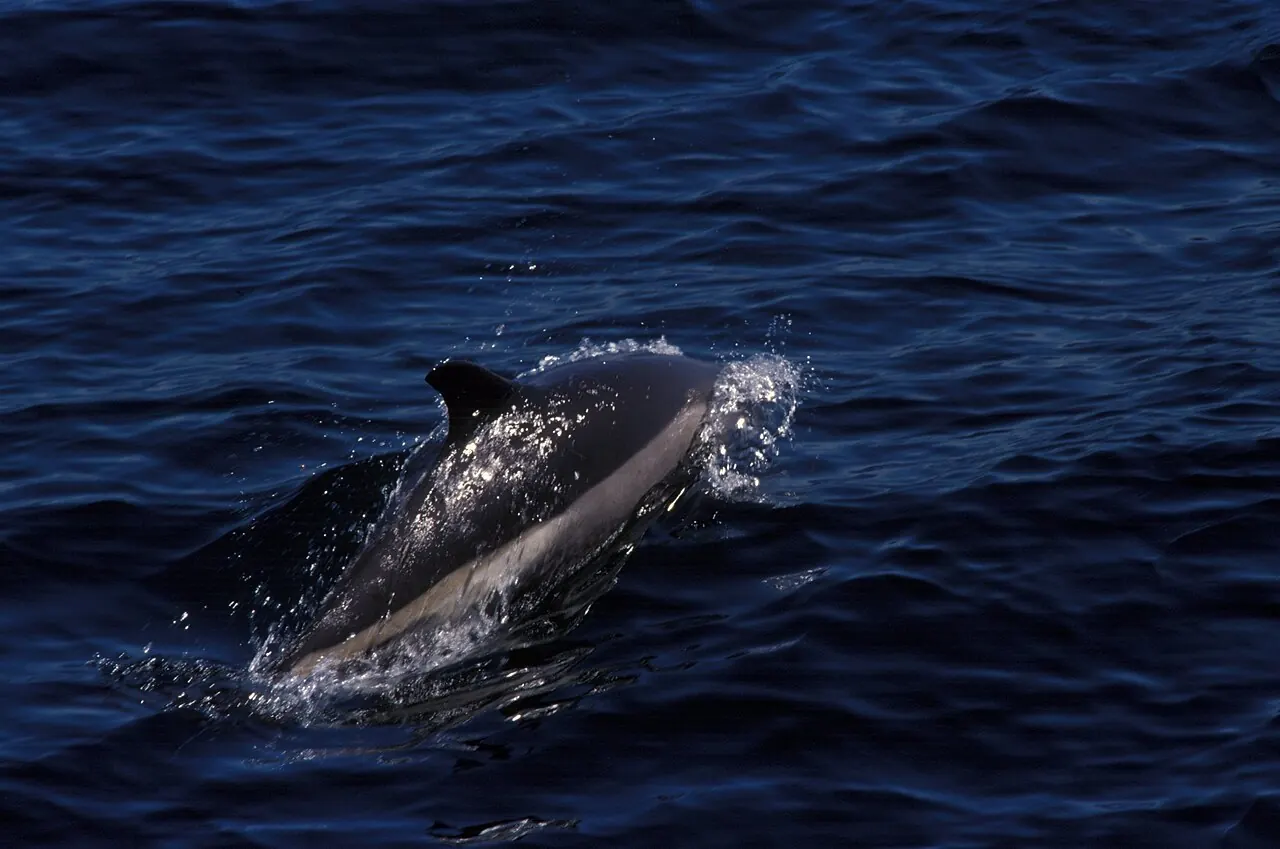
Atlantic White-sided Dolphin
Leucopleurus acutus
A fast, social dolphin of the cold North Atlantic, named for the white and yellow streaks on its sides; Cape Cod is a stranding hotspot.
Photo: Allen Shimada, NOAA/NMFS / Public domain
3 things to know
- It is named for the white patch and yellowish-tan streak along its flank.
- A 2024 mass stranding on Cape Cod that began with Atlantic white-sided dolphins off Wellfleet involved 146 dolphins, the most in US history.
- NOAA estimates about 93,000 in the western North Atlantic stock.
- Scientific name
- Leucopleurus acutus
- Depth
- 0 m – 100 m
0 – 328 ft - Size
- About 2.4–2.7 m (8–9 ft) long; males slightly larger
- Weight
- About 165–230 kg (360–505 lb)
- Lifespan
- At least 22 years
- Diet
- Schooling and bottom fish such as herring, mackerel, hake, cod, smelt and sand lance, plus squid and shrimp
- Where
- Cool temperate and subpolar North Atlantic, from about 38° to 80° N; in the US from North Carolina to Maine
- IUCN status
- Least Concern
- Depth zones
- Sunlight
A bold white patch topped by a yellowish-tan streak runs along each flank of this dolphin, below a dark gray cape and lighter gray sides, and gives it its name. The beak is very short, the upper lip dark and the lower one white, and the dorsal fin is tall and curved. NOAA Fisheries gives adults a length of about 2.4 to 2.7 meters (8 to 9 feet) and a weight of 165 to 230 kilograms (360 to 505 pounds), with males slightly larger.
This is a cold-water dolphin, found only in the North Atlantic from about 38° to 80° north, from the Gulf of Maine and Greenland to Ireland, Svalbard and the Barents Sea. It usually stays at or near the edge of the continental shelf and slope, in water colder than 12°C (54°F) and usually less than about 100 meters (330 feet) deep, a habitat figure rather than a measured dive, moving inshore and north in summer. In the United States it ranges from North Carolina to Maine, and NOAA estimates about 93,000 in the western North Atlantic stock. Groups usually hold 5 to 50 animals, and they often travel with fin and humpback whales. They eat herring, mackerel, hake, cod, smelt, sand lance, squid and shrimp.
Cape Cod is a global hotspot for live dolphin strandings. On June 28, 2024, the International Fund for Animal Welfare (IFAW) got a report of about 10 Atlantic white-sided dolphins close to shore off Wellfleet and found 125 on the mud flats of the Herring River "Gut," a hooked inlet with extreme tides. A final review counted 146 dolphins, the largest dolphin mass stranding in US history. IFAW believes 102 survived.
The species is hunted in the Faroe Islands. In September 2021 more than 1,400 dolphins were killed there in a single day, against an average of about 250 white-sided dolphins a year over the previous two decades, according to the Faroese government. After an outcry, the government proposed a provisional limit of 500 white-sided dolphins a year for 2022 and 2023.
Following a 2025 genetic study, the Society for Marine Mammalogy now places the species in the genus Leucopleurus, though the IUCN Red List still files it as Lagenorhynchus acutus and, in a 2019 assessment, lists it as Least Concern. Fishing nets are the other main threat: mid-water trawls off Ireland have caught significant numbers.
Sources
- fisheries.noaa.gov/species/atlantic-white-sided-dolphin
- iucnredlist.org/species/11141/50361160
- marinemammalscience.org/science-and-publications/list-marine-mammal-species-subspecies
- ifaw.org/press-releases/rescuing-125-dolphins-largest-single-mass-stranding-events-cape…
- ifaw.org/international/news/ifaw-responds-largest-mass-stranding-125-dolphins
- nbcnews.com/news/world/more-1-400-dolphins-killed-faroe-islands-hunt-stirring-fresh-n12…
- cbsnews.com/news/faeroe-islands-dolphin-hunt-quota



