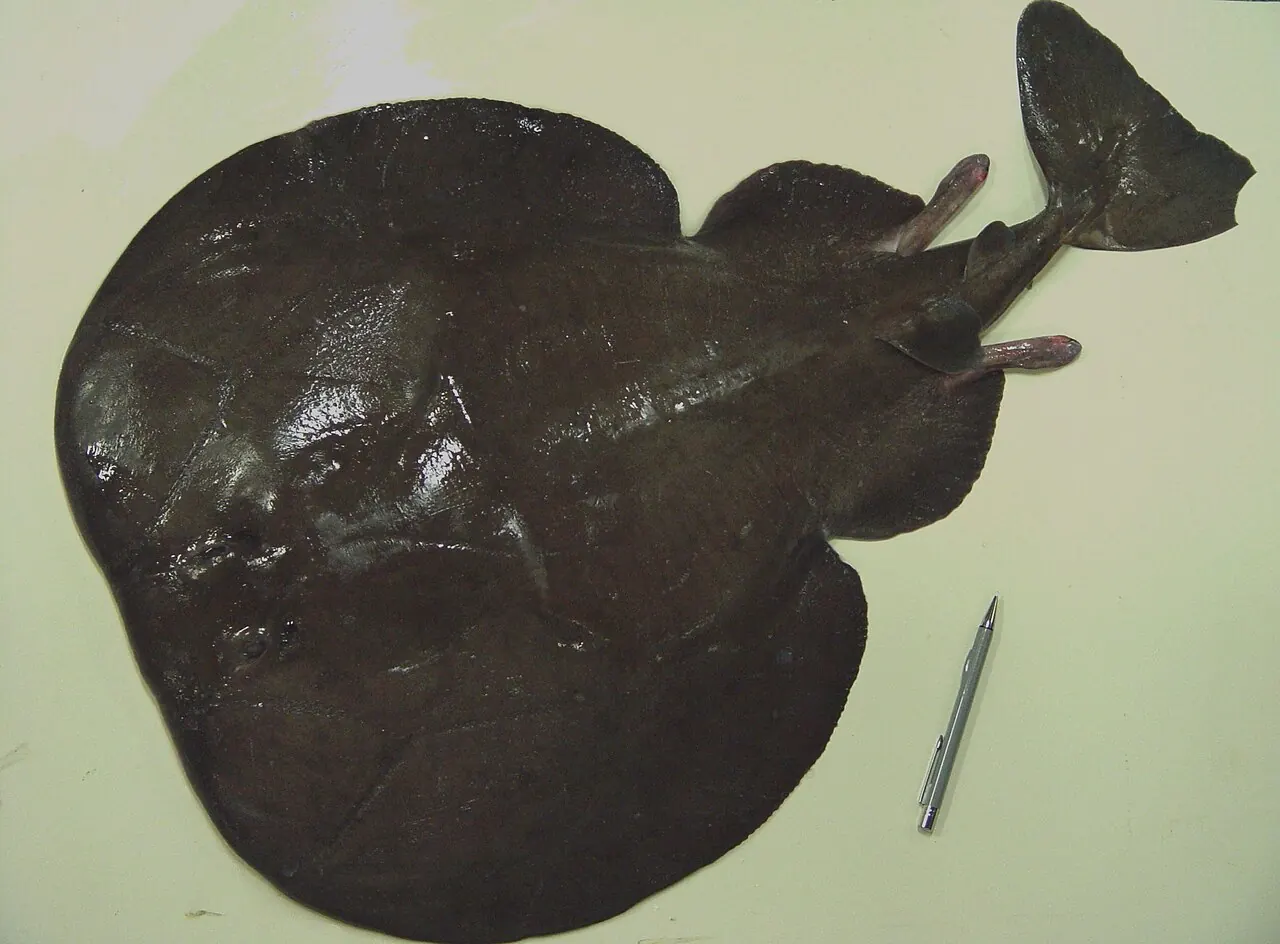
Atlantic Torpedo
Tetronarce nobiliana
A large electric ray of the Atlantic that wraps its fins around fish and stuns them with shocks of up to 220 volts.
Photo: NOAA Fisheries Collection / Public domain
3 things to know
- A large Atlantic torpedo can deliver a shock of 170 to 220 volts.
- Its electric organs are kidney-shaped and sit in the pectoral fins on either side of the head.
- In ancient Greece and Rome, its shocks were used to treat gout and headaches.
- Scientific name
- Tetronarce nobiliana
- Depth
- 10 m – 150 m
33 – 492 ft - Size
- Usually 0.6 to 1.5 m (2 to 5 ft) long; up to 1.8 m (5.9 ft)
- Weight
- Up to 90 kg (198 lb)
- Lifespan
- Unknown
- Diet
- Fishes, including flounder, mullet, dogfish and other small sharks
- Where
- Atlantic Ocean, from Nova Scotia to Brazil in the west and from Scotland to South Africa, including the Mediterranean, in the east
- IUCN status
- Least Concern
- Depth zones
- Sunlight
Touch a large Atlantic torpedo and it can hit you with 170 to 220 volts, enough to stun a person. According to the Florida Museum, the real danger to a diver is being disoriented underwater after the jolt, and the shock is extremely unlikely to stop a heart. The current comes from two kidney-shaped electric organs in the pectoral fins on either side of the head, which give the skin above them a honeycomb look.
The rest of the ray is plain. Its disc is broad and nearly round, almost straight along the front edge, with a short snout and small, widely spaced eyes. A short, thick tail carries two dorsal fins and ends in a large, paddle-shaped tail fin. It is dark gray to dark brown or nearly black on top, sometimes with white spots, and white or cream below. The skin is soft and smooth, without thorns. Most are 0.6 to 1.5 meters (2 to 5 feet) long, and the biggest reach 1.8 meters (5.9 feet) and 90 kilograms (198 pounds).
Atlantic torpedoes range from Nova Scotia to Brazil in the western Atlantic and from Scotland to South Africa in the east, including the Mediterranean but not the Black Sea. FishBase also lists records off Australia and New Zealand. Young torpedoes live on the bottom, over soft sediment or near reefs, usually 10 to 150 meters (33 to 490 feet) deep. Adults move up into open water and are reported to migrate long distances, and the species has been found as deep as 925 meters (3,035 feet).
A torpedo hunts by wrapping its pectoral fins around a fish and shocking it until it is stunned or dead. Its jaws stretch wide enough to swallow fish that look too big for its mouth. Prey includes flounder, mullet, dogfish and other small sharks. Few predators bother it. People have little use for it today either: it has no commercial value, and the IUCN's 2020 assessment lists it as Least Concern, with a stable population.
Females carry their young inside them for about a year, feeding them first on yolk and then on a nourishing uterine fluid, and release up to 60 pups about 20 centimeters (8 inches) long.
It was not always ignored. In ancient Greece and Rome its shock was used to treat gout and headaches, and the ray's liver oil was valued as lamp fuel before kerosene.



