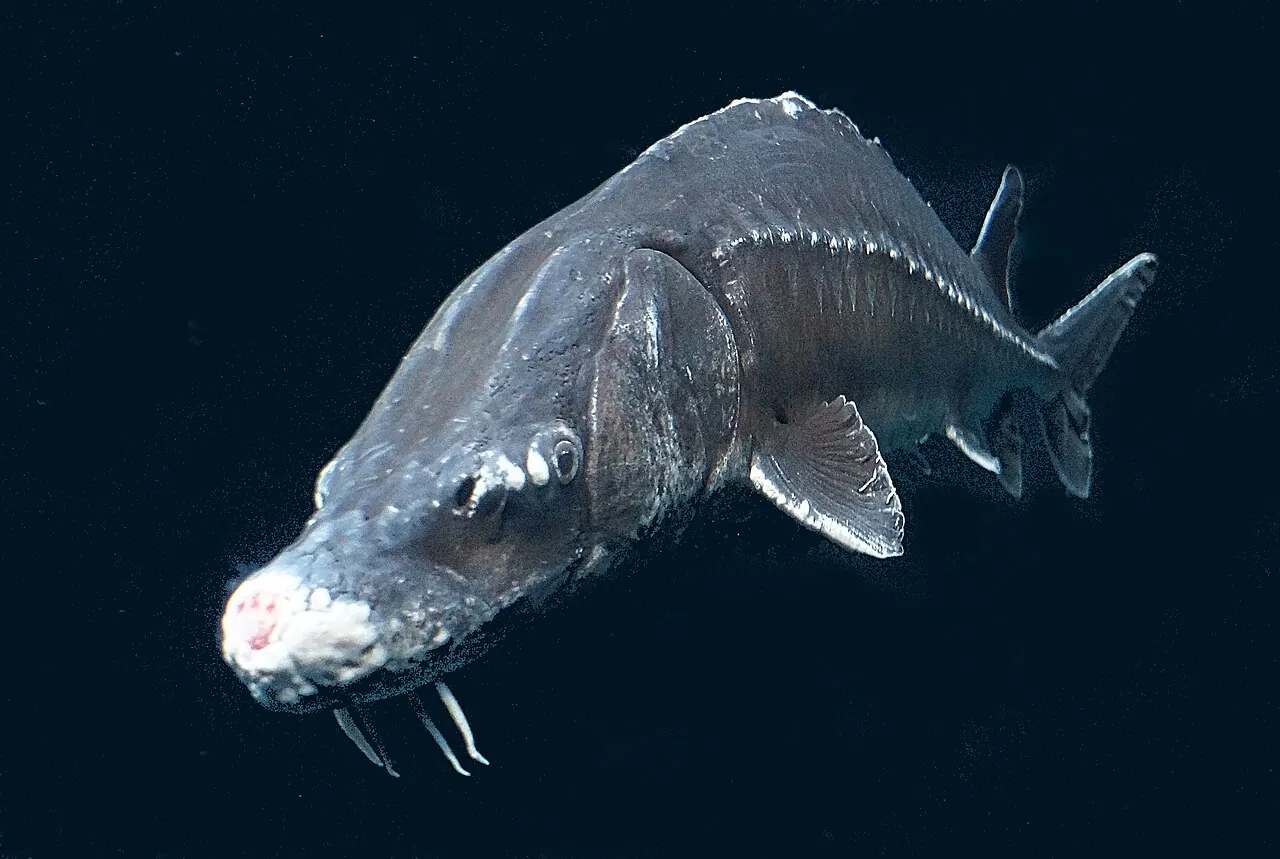
Atlantic Sturgeon
Acipenser oxyrinchus oxyrinchus
A bony-plated giant of East Coast rivers that can live 60 years, once fished for caviar and now protected under the Endangered Species Act.
Photo: Pierre André Leclercq / CC BY 4.0
3 things to know
- Five rows of bony plates called scutes run along its body.
- A female lays between 400,000 and 2 million eggs, depending on her age and size.
- All five US populations are listed under the Endangered Species Act, four as endangered and one as threatened.
- Scientific name
- Acipenser oxyrinchus oxyrinchus
- Depth
- 0 m – 100 m
0 – 328 ft - Size
- Up to about 4.3 m (14 ft) long
- Weight
- Up to about 360 kg (800 lb)
- Lifespan
- Up to 60 years
- Diet
- Bottom animals such as crustaceans, worms and mollusks, and bottom fish such as sand lance
- Where
- Rivers, estuaries and coastal waters of the Atlantic coast of North America, from Labrador to Florida
- IUCN status
- Vulnerable
- Depth zones
- Sunlight
Five rows of bony plates called scutes run along the back and sides of an Atlantic sturgeon, and four soft barbels hang in front of its mouth, under a pointed snout. The tail is lopsided like a shark's, with one lobe larger than the other. NOAA Fisheries describes the back as bluish-black or olive brown, with paler sides and a white belly, and records fish up to 14 feet (4.3 meters) long, 800 pounds (360 kilograms) and 60 years old.
It ranges along the Atlantic coast of North America from Labrador to Florida. Sturgeon hatch in fresh water, drift down to brackish water where they may stay one to five years, then move out to the coast. The IUCN gives its depth range as 0 to 100 meters (330 feet). Tagging shows that young fish travel up and down the East Coast and as far as Iceland. Adults usually return to spawn in the river where they hatched. They feed on the bottom, on crustaceans, worms, mollusks and fish such as sand lance. Cold water slows their growth and delays maturity: fish from the St. Lawrence River mature at 22 to 34 years, those from South Carolina at 5 to 19. A female lays 400,000 to 2 million eggs, and in the Hudson River she reaches half her lifetime egg production only at about 29.
People have eaten sturgeon for a very long time. NOAA notes that Indigenous tribes harvested the meat and eggs some 4,000 years ago, and credits sturgeon as the main food that saved the Jamestown settlers in 1607. In the late 1800s, demand for sturgeon roe as caviar set off what NOAA calls the "Black Gold Rush," and by the early 1900s the populations had declined drastically. A coastwide ban on harvest has been in place since 1998.
In 2012, NOAA listed five distinct US populations under the Endangered Species Act: Gulf of Maine fish as threatened, and the New York Bight, Chesapeake Bay, Carolina and South Atlantic populations as endangered. Bycatch in fishing gear, dams, poor water quality, dredging and ship strikes are the main threats. The Atlantic States Marine Fisheries Commission's 2024 assessment update found the species still depleted coastwide, but likely more abundant in 2022 than in 1998, with mixed results among the five populations. The IUCN lists the Atlantic sturgeon as Vulnerable, with its population increasing.



