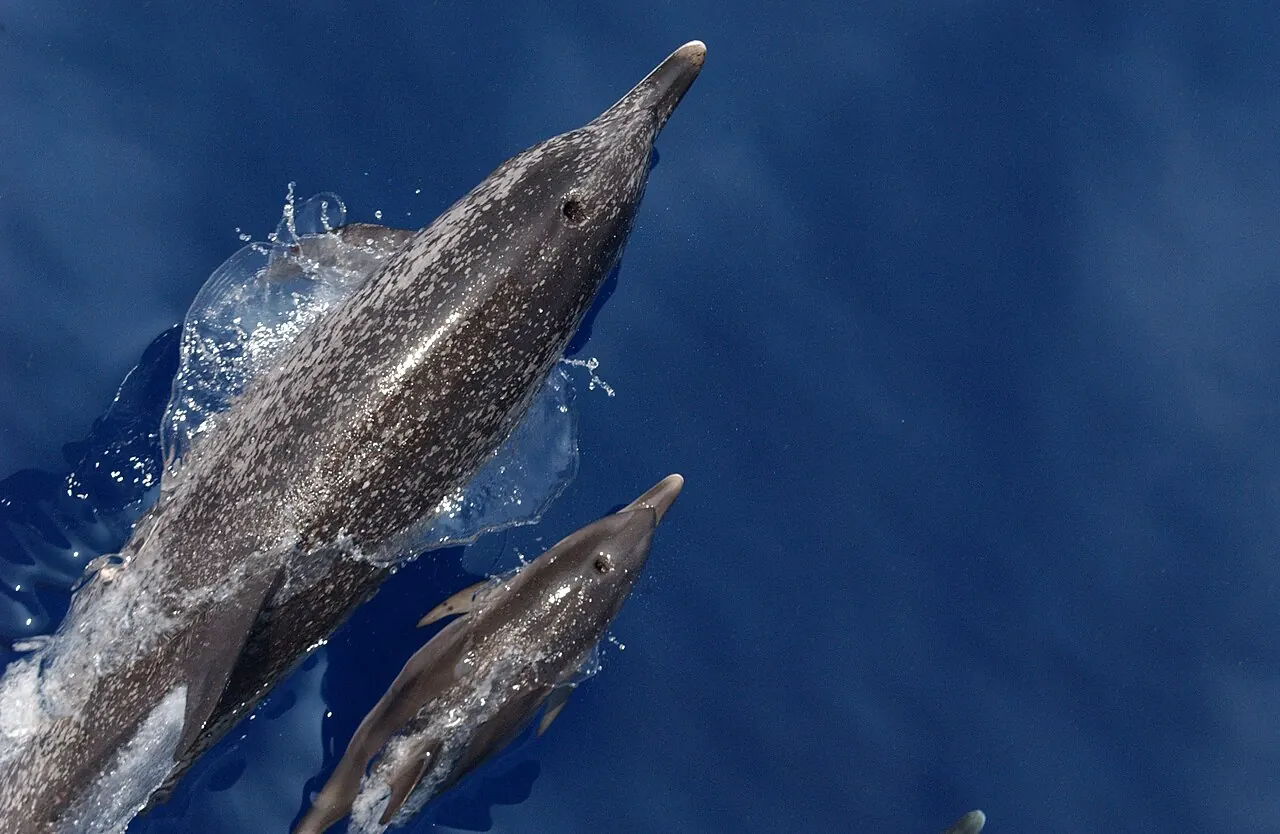
Atlantic Spotted Dolphin
Stenella frontalis
An Atlantic dolphin born without spots, studied underwater for more than 30 years by the Wild Dolphin Project in the Bahamas.
Photo: Wayne Hoggard, NOAA/NMFS/SEFSC / Public domain
3 things to know
- Calves have no spots; the spots start to appear after about a year.
- NOAA estimates more than 77,000 live in US waters.
- Some dig into the sandy seafloor with their beaks to catch hidden fish.
- Scientific name
- Stenella frontalis
- Depth
- 0 m – 10 m
0 – 33 ft - Size
- About 1.5–2.3 m (5–7.5 ft) long
- Weight
- About 100–143 kg (220–315 lb)
- Lifespan
- Unknown
- Diet
- Small fish, invertebrates, squid and octopus
- Where
- Warm temperate to tropical Atlantic Ocean
- IUCN status
- Least Concern
- Depth zones
- Sunlight
Young Atlantic spotted dolphins have no spots at all. A calf has a dark gray back and a pale white belly and can pass for a slender bottlenose dolphin. Spots begin to show after about a year, then grow darker and spread as the animal ages, especially across the back. Adults reach about 1.5 to 2.3 meters (5 to 7.5 feet) and 100 to 143 kilograms (220 to 315 pounds), with a moderately long beak, a tall curved dorsal fin and a pale blaze sweeping up each side.
The species lives only in the Atlantic, in warm temperate and tropical water: along the US East Coast from southern New England to the Gulf of Mexico, and off the Bahamas, Brazil, the Azores, the Canary Islands and Gabon. Most stay over the continental shelf, in water 20 to 250 meters (65 to 820 feet) deep. NOAA estimates more than 77,000 live in US waters.
They eat small fish, invertebrates, squid and octopus, often coordinating as a group to catch prey, and some dig into the sand with their beaks for buried fish. Most dives are shallower than about 10 meters (30 feet) and last 2 to 6 minutes, but they can reach about 60 meters (200 feet) and hold their breath for up to 10 minutes. Females mature at 8 to 15 years and have a single calf every 1 to 5 years. How long they live is unknown.
Off the Bahamas, the Wild Dolphin Project, directed by Denise Herzing, has more than 30 years of records on Atlantic spotted dolphins, covering four generations. The team identifies each dolphin by its markings, collects feces from the water for DNA to work out fathers and grandfathers, and watches the spotted dolphins mix with local bottlenose dolphins, checking for possible hybrids. With Thad Starner's group at Georgia Tech, the project built CHAT, an underwater computer that plays invented whistles as names for play objects such as a scarf and sargassum, a natural toy for the dolphins. During one August field season the system recognized an incoming whistle as its "sargassum" label; the team noted a dolphin may simply have been mimicking the whistle, or the computer may have matched a near miss.
Fishing gear, ocean noise and illegal feeding are the main threats. The IUCN lists the species as Least Concern, and the Marine Mammal Protection Act protects it in US waters.
Sources
- fisheries.noaa.gov/species/atlantic-spotted-dolphin
- wilddolphinproject.org/our-research/goals-and-objectives
- wilddolphinproject.org/our-research/chat-research
- wilddolphinproject.org/about-us/mission-and-vision
- Study: doi:10.2305/IUCN.UK.2018-2.RLTS.T20732A50375312.en
- iucn-csg.org/red-list-status-of-cetaceans



