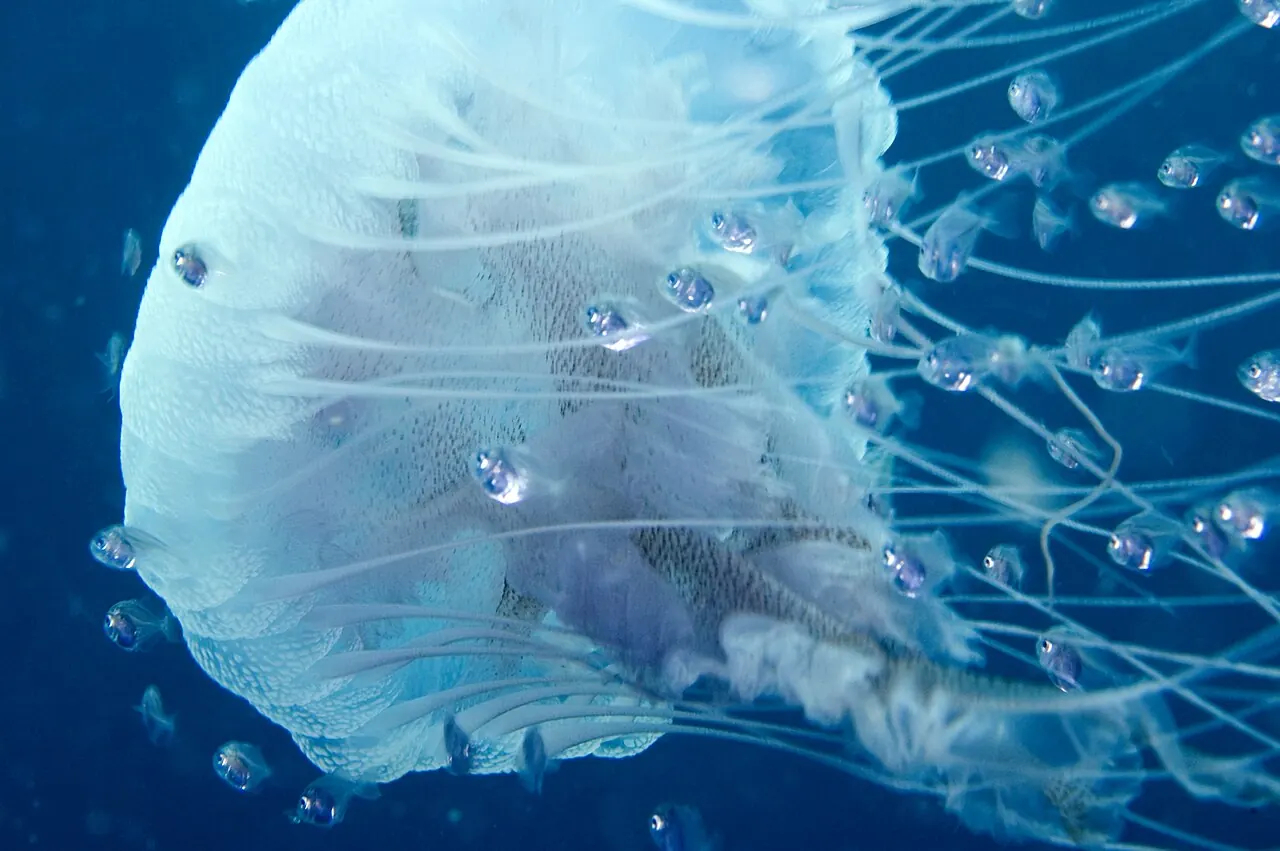
Atlantic Sea Nettle
Chrysaora quinquecirrha
The open-coast sea nettle of the US East Coast, recognized in 2017 as a separate species from the Chesapeake Bay's bay nettle.
Photo: Greg McFall, Gray's Reef National Marine Sanctuary, NOAA / Public domain
3 things to know
- It has about five tentacles in each eighth of its bell, roughly 40 in all.
- Since 2017, the common nettle of Chesapeake Bay has been treated as a separate species, the Atlantic bay nettle.
- Older records that lump both species say sea nettles shelter young harvestfish.
- Scientific name
- Chrysaora quinquecirrha
- Depth
- 0 m – 85 m
0 – 279 ft - Size
- Bell up to about 40 cm (16 in) across
- Weight
- Unknown
- Lifespan
- Unknown
- Diet
- Little studied; sea nettles in the broad sense eat polychaete worms and comb jellies
- Where
- Open coastal waters of the US Atlantic coast, from south of Cape Cod to at least Georgia and northern Florida
- IUCN status
- Not Evaluated
- Depth zones
- Sunlight
Two jellyfish shared the name Chrysaora quinquecirrha for decades. In 2017 Keith Bayha, Allen Collins and Patrick Gaffney compared DNA and anatomy from sea nettles collected along the US Atlantic and Gulf of Mexico coasts, published the results in PeerJ, and found two separate species. The name C. quinquecirrha, coined by Desor in 1848 and tied to Nantucket, Massachusetts, stays with the one that lives in open coastal water, which the authors call the U.S. Atlantic sea nettle. The familiar nettle of Chesapeake Bay, other Atlantic estuaries and the Gulf of Mexico became Chrysaora chesapeakei, the Atlantic bay nettle.
The coastal species is found south of Cape Cod to at least Georgia and northern Florida. Its bell grows to about 40 centimeters (16 inches) across and is almost hemispherical, white to transparent with at most faint radial marks. One way to tell the two apart is to count tentacles: the sea nettle has about five in each eighth of its bell, roughly 40 in all, while the bay nettle has three per eighth, 24 in all. The sea nettle's oral arms are short, about as long as the bell is wide; the bay nettle's average about three times the bell's width.
Because the two were lumped together, most of what is known about "sea nettles" comes from the bay species. Bayha's team wrote that almost no ecological studies have been done on the coastal one, apart from an older survey that found the largest individual about 90 kilometers (56 miles) offshore in full-strength seawater. SeaLifeBase's record, written for sea nettles in that broad sense, gives a depth range of 0 to 85 meters (280 feet), lists polychaete worms and comb jellies as food and says the jellies shelter young harvestfish. Sea nettles alternate between a fixed polyp stage, which buds off young jellyfish in spring and summer, and the swimming medusa. Their family is known for painful stings that can affect fisheries and beach tourism.
The species has not been assessed for the IUCN Red List.



