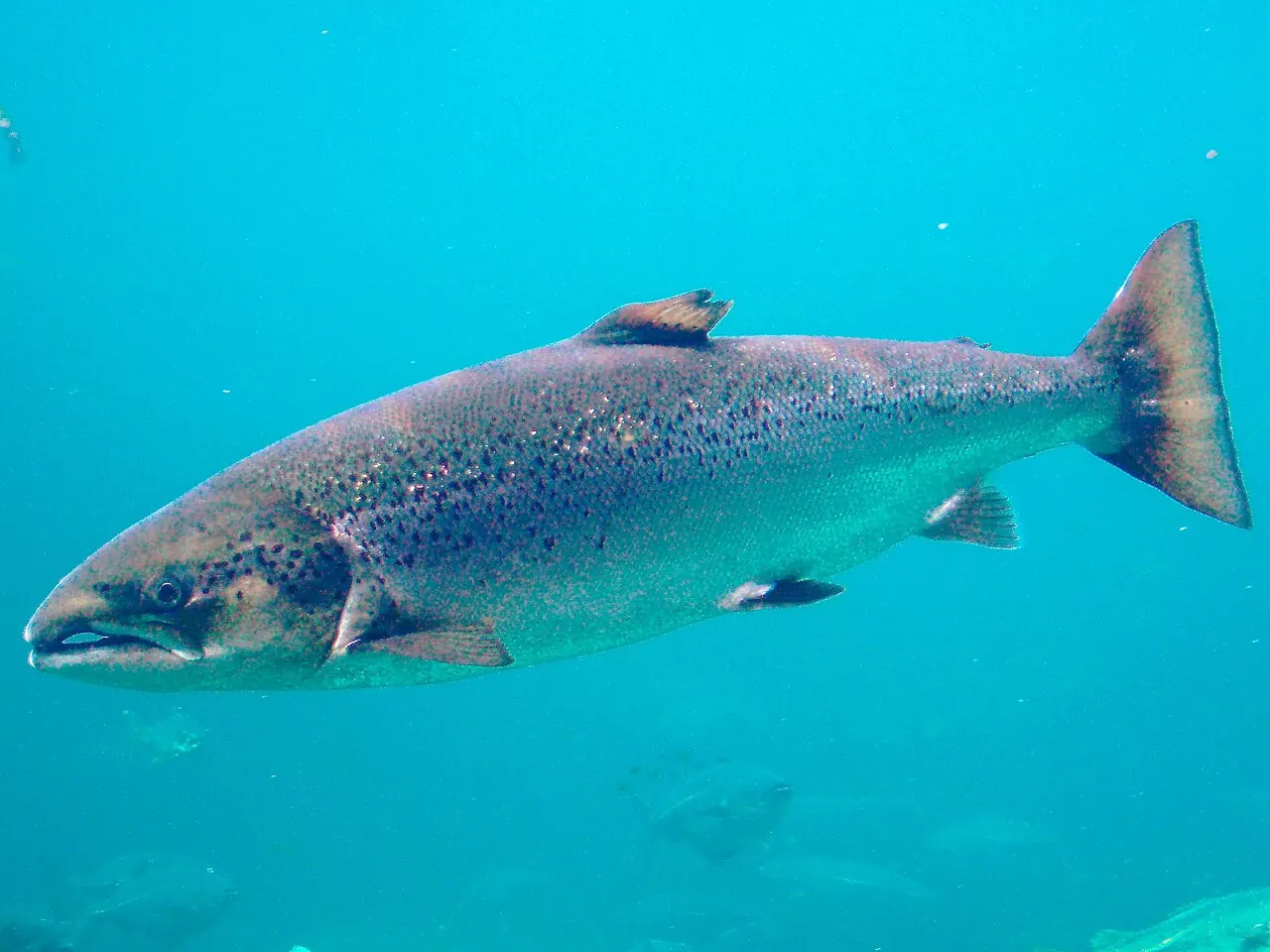
Atlantic Salmon
Salmo salar
A silver fish that hatches in rivers, feeds at sea as far north as Svalbard, then swims back to its home river to spawn.
Photo: Hans-Petter Fjeld / CC BY-SA 2.5
3 things to know
- Salmon from Maine spend their first winter at sea south of Greenland.
- Satellite tags have recorded Atlantic salmon diving as deep as 870 meters (2,850 feet).
- Unlike Pacific salmon, an Atlantic salmon can survive spawning and come back to spawn again.
- Scientific name
- Salmo salar
- Depth
- 0 m – 210 m
0 – 689 ft - Size
- Up to 150 cm (59 in); adults after two winters at sea average 71 to 76 cm (28 to 30 in)
- Weight
- Record about 46.8 kg (103 lb); adults after two winters at sea average 3.6 to 5.4 kg (8 to 12 lb)
- Lifespan
- Most live 4 to 6 years; up to about 13 years reported
- Diet
- At sea, mostly fish such as herring, capelin and sand lance; also squid and shrimp
- Where
- Rivers of northeastern North America, Iceland, Europe and northwestern Russia; feeds at sea as far as Greenland, Svalbard and the Barents Sea
- IUCN status
- Near Threatened
- Depth zones
- Sunlight · Twilight
Every wild Atlantic salmon still hatching in the United States starts life in a river in central or eastern Maine. The species is anadromous: it hatches in fresh water, spends a few years there as a spotted, bronze-colored juvenile called a parr, then turns silver and goes to sea to feed and grow before returning to its home river to spawn. At sea it is bluish green above and silver below, with a few black spots. FishBase gives a record of 150 centimeters (59 inches) and 46.8 kilograms (103 pounds), but NOAA Fisheries says a fish back from two winters at sea averages 71 to 76 centimeters (28 to 30 inches) long and 3.6 to 5.4 kilograms (8 to 12 pounds).
NOAA Fisheries traces the ocean trip of Maine fish. Young salmon leave the rivers in spring and reach the waters off Newfoundland and Labrador by midsummer. They spend their first winter at sea south of Greenland and feed through the next season off West Greenland. Adults at sea eat mostly fish, such as herring and capelin, and most return home after one to three years. Unlike Pacific salmon, it can survive spawning and make the trip again, though repeat spawners are getting rare.
In a 2021 study in Scientific Reports, Audun Rikardsen and colleagues described 204 pop-up tags fitted to salmon leaving rivers in seven parts of Europe and to North American fish caught at sea off West Greenland. Some Norwegian and Danish salmon reached the waters west of Svalbard, at nearly 80 degrees north, farther than previously reported. They spent about 80 percent of their time within 10 meters (33 feet) of the surface, but the deepest dives in different groups ranged from 220 to 870 meters (720 to 2,850 feet). Diving picked up near ocean fronts, where Atlantic water meets cold polar water, and the authors read those dives as feeding.
In December 2023 the IUCN moved the species from Least Concern to Near Threatened, citing a 23 percent fall in the global population between 2006 and 2020. Among the threats it named are dams, polluted rivers, climate change, interbreeding with escaped farmed salmon and lice from salmon farms. In the United States, fishing for them is banned, the Gulf of Maine population is listed as endangered under the Endangered Species Act, and all Atlantic salmon sold in stores is farm-raised.



