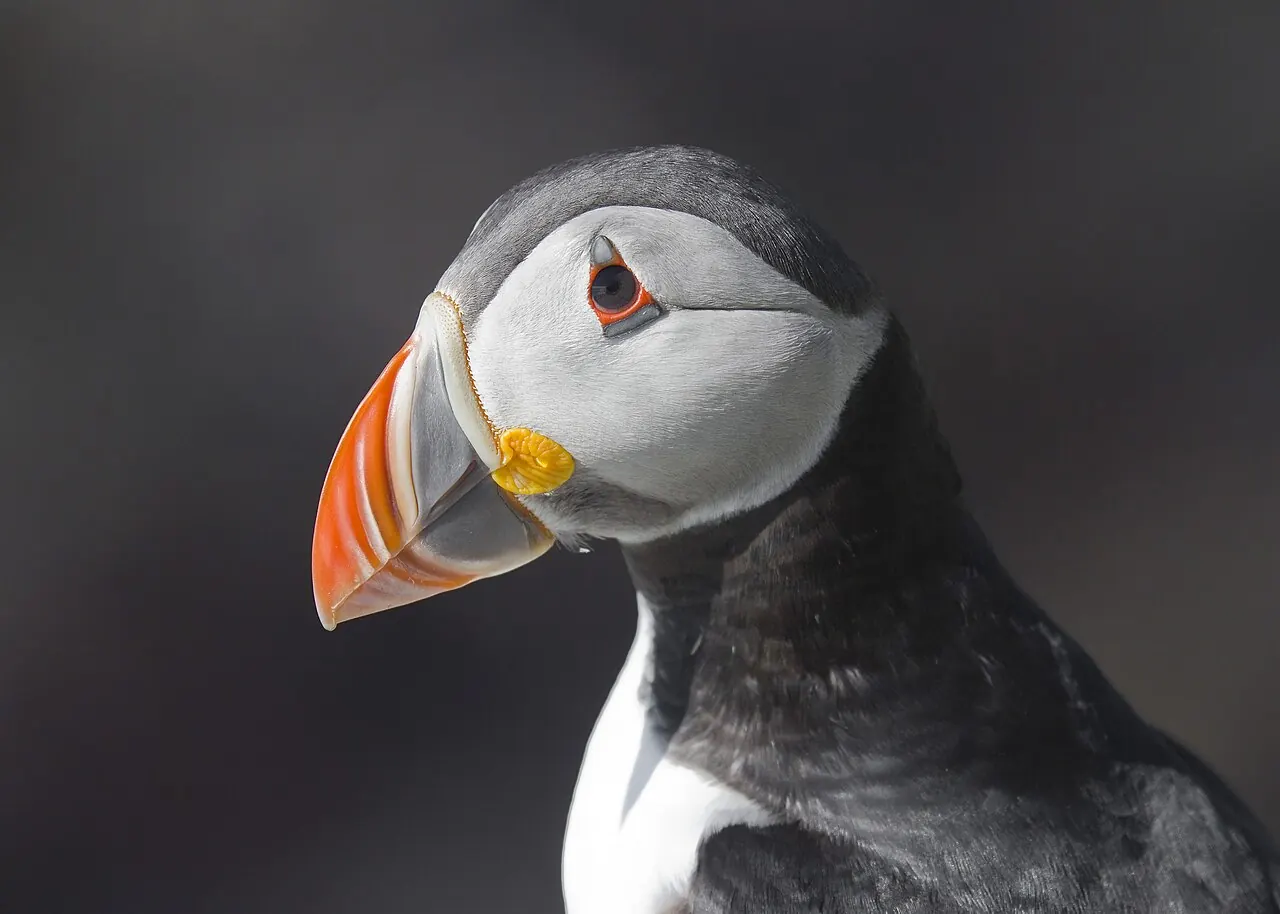
Atlantic Puffin
Fratercula arctica
A crow-sized North Atlantic seabird with a seasonal striped bill, brought back to Maine's islands by Audubon's Project Puffin.
Photo: Andreas Trepte / CC BY-SA 2.5
3 things to know
- It sheds the outer plates of its colorful bill after the breeding season.
- Most of its fishing happens within 15 m (50 ft) of the surface.
- Puffins nest again on Eastern Egg Rock, Maine, after a project to move chicks there began in 1973.
- Scientific name
- Fratercula arctica
- Depth
- 0 m – 15 m
0 – 49 ft - Size
- About 25–33 cm (10–13 in) long, with a wingspan of 47–63 cm (18–25 in)
- Weight
- About 310–550 g (11–19 oz)
- Lifespan
- Typical life expectancy about 18 years for a bird that reaches breeding age; the BTO ringing record is 42 years
- Diet
- Small fish such as sand lance, herring and capelin, plus crustaceans
- Where
- North Atlantic; in the US it nests on islands off Maine and winters as far south as Maryland
- IUCN status
- Vulnerable
- Depth zones
- Sunlight
In summer the Atlantic puffin's bill is a striped wedge of orange, gray and yellow, and much of it is temporary. After breeding the bird sheds the bill's outer plates, and in winter the bill is smaller and duller and the face grayer. Adults are 25 to 33 centimeters (10 to 13 inches) long, about the size of a crow, and weigh 310 to 550 grams (11 to 19 ounces).
Puffins spend most of the year on the open North Atlantic, wintering in North American waters from the edge of the pack ice south to Maryland, and come ashore only to breed in colonies on sea islands. A pair nests in a burrow about 1 to 2 meters (3 to 7 feet) long, or in a crevice among rocks, and usually lays a single egg. Both parents incubate it, most often for 39 to 42 days, and both feed the chick, flying in with small fish such as sand lance, herring and capelin carried in the bill. Most foraging happens within 15 meters (50 feet) of the surface, though Audubon says a puffin can dive to about 60 meters (200 feet).
Puffins can live for decades. The British Trust for Ornithology gives a typical life expectancy of 18 years for a bird that reaches breeding age, which is usually at about five, and its ringing record is a puffin that reached 42 years and 21 days, set in 2019.
In Maine, decades of overhunting wiped out every colony except the one on Matinicus Rock. In 1973 Stephen Kress, then a 28-year-old environmental educator, began moving chicks from Great Island, Newfoundland, to Eastern Egg Rock, a former nesting island off Maine; he was allowed six chicks that first year. His team set out dozens of wooden decoys. On July 4, 1981, Evie Weinstein saw a puffin carrying a beakful of fish on the island, the first sign that the birds were nesting there. Audubon now counts about 1,300 breeding pairs on five Maine islands.
Worldwide the IUCN lists the Atlantic puffin as Vulnerable, in a 2018 assessment. Audubon notes that at the southernmost colonies, puffins have poor breeding success in years when the water runs warm.



