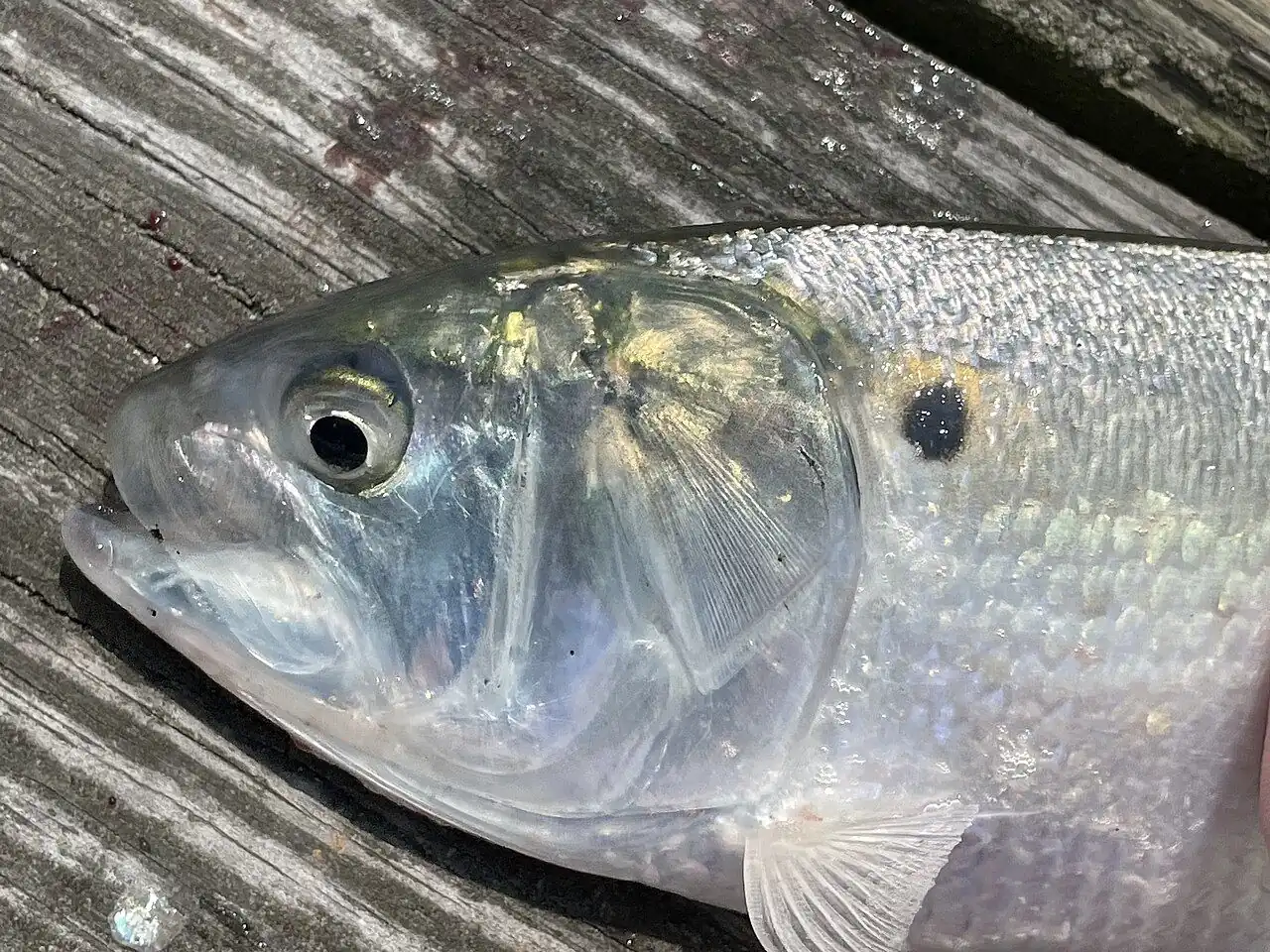
Atlantic Menhaden
Brevoortia tyrannus
A schooling filter feeder of the US East Coast that feeds striped bass and ospreys and supports the coast's biggest fishery by volume.
Photo: Bobby McCabe / CC BY 4.0
3 things to know
- Menhaden make up the largest landings by volume of any fishery on the US Atlantic coast.
- Well-fed menhaden are known as fatbacks or bunkers.
- Since 2020, catch limits have been set with menhaden's predators, especially striped bass, in mind.
- Scientific name
- Brevoortia tyrannus
- Depth
- 0 m – 50 m
0 – 164 ft - Size
- Up to about 38 cm (15 in) according to NOAA Fisheries; FishBase lists 50 cm (20 in)
- Weight
- About 0.45 kg (1 lb) when fully grown
- Lifespan
- Up to 10 to 12 years
- Diet
- Phytoplankton and zooplankton filtered from the water
- Where
- Coastal and estuarine waters of the western Atlantic from Nova Scotia to northern Florida
- IUCN status
- Least Concern
- Depth zones
- Sunlight
Atlantic menhaden are silvery fish with brassy sides, a dark bluish-green back and a distinct black spot on the shoulder just behind the gill opening, often followed by rows of smaller spots along the flank. NOAA Fisheries says they reach about 38 centimeters (15 inches) and roughly half a kilogram (1 pound), and live 10 to 12 years. When they are well fed, people call them fatbacks or bunkers.
They live in coastal and estuarine water from Nova Scotia to northern Florida, swimming in large, tightly packed schools near the surface from spring through fall, and some move into deeper water in winter. Menhaden are filter feeders. They strain phytoplankton and zooplankton out of the water as they swim, and in turn feed striped bass, bluefish, weakfish and other fish, along with ospreys and eagles. Adults spawn in coastal ocean water, with a peak thought to be December to February. The larvae drift into bays such as the Chesapeake and Delaware Bay, where juveniles spend about a year before joining the adult schools.
Most menhaden are caught with purse seines and "reduced" into fish meal, fish oil and fish solubles, an industry that started in New England in the early 1800s. According to the Atlantic States Marine Fisheries Commission (ASMFC), reduction landings peaked in 1956 at 712,100 metric tons, when more than 20 reduction factories stood between southern Maine and northern Florida. Today the oil goes into supplements and the meal into animal and fish feed, and bait for blue crab and lobster traps is a growing share: bait and recreational landings made up 35 percent of the 2025 catch.
Menhaden are now managed partly as food for other fish. In 2020 the ASMFC began setting catch limits with ecological reference points, fishing targets meant to leave enough menhaden for predators, with striped bass as the guide species. Under the 2025 assessment the stock is not overfished, but fishing was above the new target, and the commission cut the 2026 coastwide limit by 20 percent, to 186,840 metric tons. It has also capped the reduction catch in Chesapeake Bay, a nursery for striped bass, since 2006, and that cap is set to fall to 37,123 metric tons in 2027. The IUCN lists the species as Least Concern, from a 2015 assessment.



