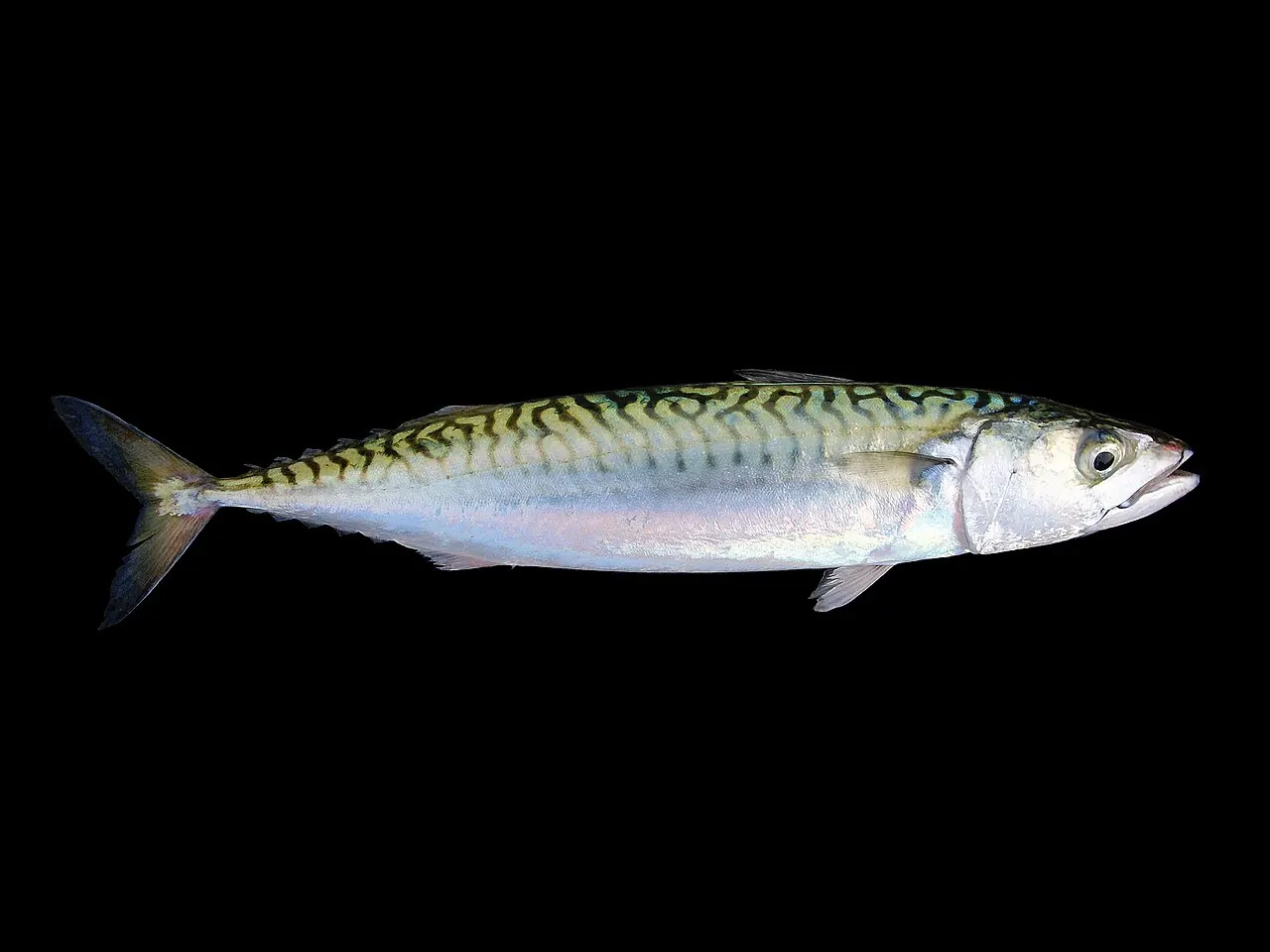
Atlantic Mackerel
Scomber scombrus
A striped schooling fish with no swim bladder, whose northeast Atlantic schools pushed into Greenland's waters as the sea warmed.
Photo: Hans Hillewaert / CC BY-SA 4.0
3 things to know
- Atlantic mackerel have no swim bladder.
- A female can carry between 285,000 and almost 2 million eggs, released in five to seven batches.
- Mackerel were first recorded off east Greenland in 2011, and by 2014 the fishery made up 23 percent of Greenland's export value.
- Scientific name
- Scomber scombrus
- Depth
- 0 m – 200 m
0 – 656 ft - Size
- Up to about 42 cm (16.5 in) in US waters; FishBase lists up to 60 cm (24 in) fork length
- Weight
- Up to about 1 kg (2.2 lb) in US waters; FishBase lists a maximum of 3.4 kg (7.5 lb)
- Lifespan
- Up to 20 years
- Diet
- Copepods, krill and shrimp, plus squid, small fish and sea squirts
- Where
- Both sides of the North Atlantic, including the Mediterranean and Baltic Seas; in the west from Labrador to North Carolina
- IUCN status
- Least Concern
- Depth zones
- Sunlight
Twenty to thirty wavy black bars cross the back of an Atlantic mackerel, over iridescent blue-green, with a narrow dark streak running below them and a plain silvery-white belly. The body is a smooth spindle, tapered at both ends. NOAA Fisheries notes that the colors fade quickly after the fish dies.
The Atlantic mackerel has no swim bladder, the gas-filled organ that lets many bony fish hold their depth without swimming. It lives in big schools near the surface over cold and temperate continental shelves on both sides of the North Atlantic, from Labrador to North Carolina in the west. Mackerel spend the winter in deeper water and move toward shore in spring when the water reaches about 11 to 14°C (52 to 57°F). They feed mostly by day, on copepods, krill and shrimp, along with squid, small fish and sea squirts.
In the western Atlantic there are two major spawning groups. The southern group spawns mainly in the Mid-Atlantic Bight in April and May, and the northern group in Canada's Gulf of St. Lawrence in June and July, both usually 16 to 48 kilometers (10 to 30 miles) offshore. A female carries between 285,000 and almost 2 million eggs, depending on her size, and releases them in five to seven batches. The eggs float near the surface and hatch in 4 to 7.5 days.
The northeast Atlantic mackerel stock has been on the move. Teunis Jansen and colleagues reported that these mackerel were first recorded in the Irminger Current off east Greenland in 2011, the farthest northwest the species had been found in the Atlantic, as summer water temperatures there hit record highs. A 2014 survey found roughly 1 million metric tons of mackerel off southeast Greenland, mostly in surface water warmer than 8.5°C (47°F). A fishery grew so fast that in 2014 it made up 23 percent of the value of all Greenland's exports.
The IUCN lists the species as Least Concern. NOAA's 2025 assessment found the US stock not overfished and not subject to overfishing, but still rebuilding toward its target. In 2024, US anglers landed more Atlantic mackerel, 2.6 million pounds, than commercial boats did, at 2 million pounds.



