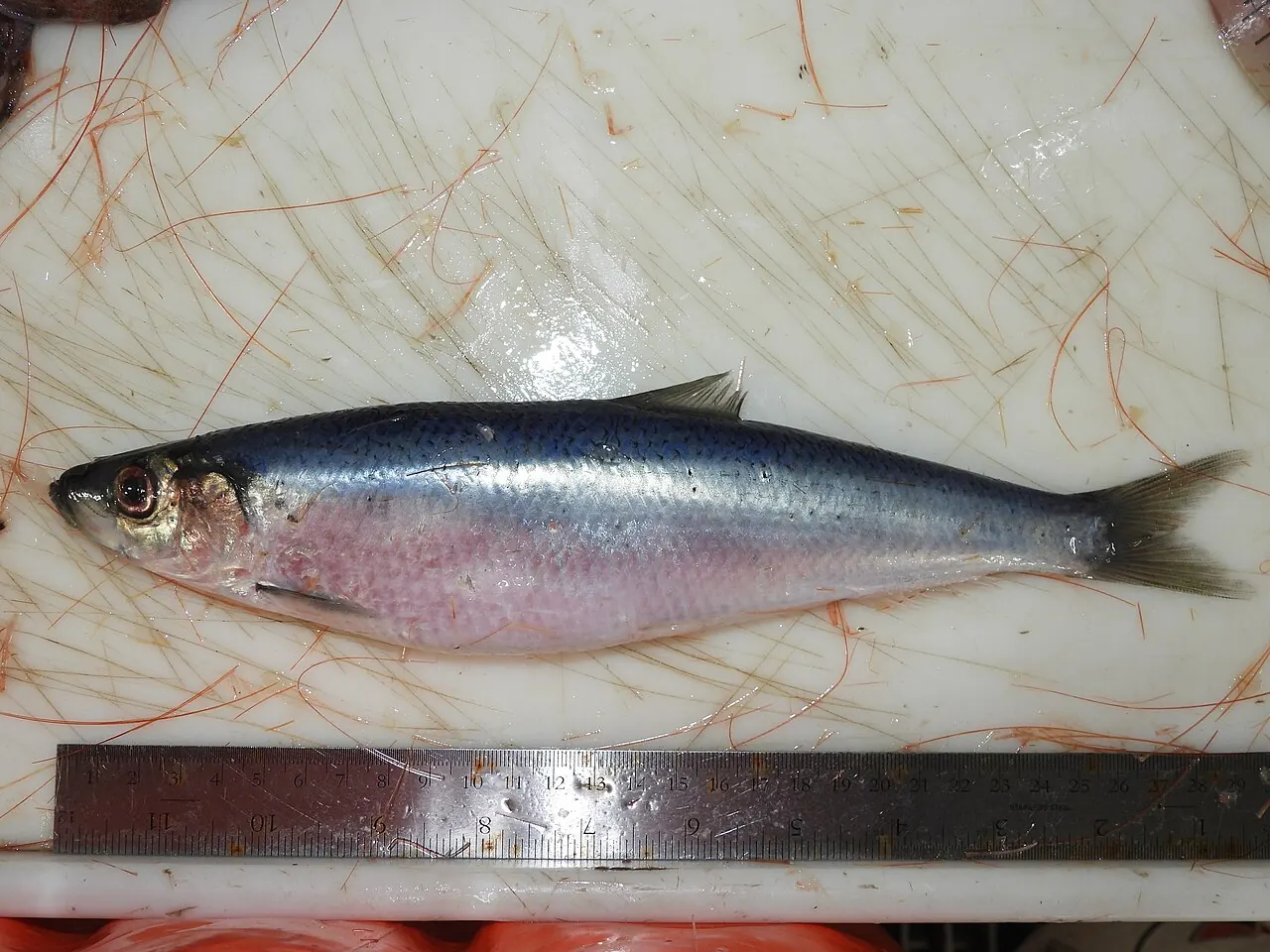
Atlantic Herring
Clupea harengus
A schooling North Atlantic fish whose eggs can carpet the seafloor, and whose bubble-driven ticking sounds won an Ig Nobel Prize.
Photo: savoieju / CC BY 4.0
3 things to know
- Herring schools can lay so many eggs that they cover the seafloor in a carpet several centimeters thick.
- Captive Atlantic herring were filmed releasing bubbles from near the anus while making bursts of ticking sounds.
- Atlantic herring can hear sounds from about 30 to 4,000 hertz.
- Scientific name
- Clupea harengus
- Depth
- 0 m – 200 m
0 – 656 ft - Size
- Up to about 36 cm (14 in) in US waters; FishBase lists up to 45 cm (18 in)
- Weight
- Up to about 1.1 kg (2.4 lb)
- Lifespan
- Up to about 15 years; ages up to 25 years have been reported
- Diet
- Zooplankton, mainly copepods, plus krill and fish larvae
- Where
- Both sides of the North Atlantic, including the Baltic Sea; in the west from Greenland and Labrador to the Carolinas
- IUCN status
- Least Concern
- Depth zones
- Sunlight
Atlantic herring are slim, silver fish with blue to greenish-blue backs and rounded bellies, and they spend their lives in schools. They live on both sides of the North Atlantic, from Labrador to the Carolinas in the west and from Iceland to the Bay of Biscay and the Baltic Sea in the east, usually in the top 200 meters (650 feet). Adults generally spend the day deeper and rise toward the surface at night. FishBase notes that schools move between feeding, wintering and spawning grounds along routes the young fish learn from older ones.
They eat mostly copepods and other tiny drifting animals, which they find by sight. When the food is dense enough, a herring can switch to filter feeding. Herring also have excellent hearing, picking up sounds from about 30 to 4,000 hertz, and their schooling, shiny sides and very fast escape reactions all help protect them from the fish, seabirds and marine mammals that hunt them.
They make sounds too. In 2004, Ben Wilson, Robert Batty and Lawrence Dill described bursts of rapid pulses from captive Pacific herring that they called Fast Repetitive Tick sounds, each lasting from 0.6 to 7.6 seconds and made mostly at night. Atlantic herring made them too, and video linked the ticks to bubbles released from the anal duct region. The herring made more sounds per fish when crowded, so the authors suggested the sounds may play a social role, though their purpose is still unknown. That work, together with research by Magnus Wahlberg and Håkan Westerberg, won the 2004 Ig Nobel Prize in biology.
Each population returns to traditional spawning grounds once a year, often over gravel or rock in shallow coastal water. Females lay tens of thousands of sticky eggs that sink and cling to the bottom, and NOAA Fisheries says schools can leave a carpet of eggs several centimeters thick. Flounder, cod, haddock and red hake eat the eggs, which usually hatch in 7 to 10 days.
The IUCN lists the species as Least Concern. In US waters, the 2024 stock assessment found Atlantic herring overfished but not subject to overfishing, and a rebuilding plan has a target date of 2031. Herring are sold frozen, salted or canned, and lobster, blue crab and tuna fishermen use them as bait.
Sources
- fisheries.noaa.gov/species/atlantic-herring
- fishbase.se/summary/Clupea-harengus.html
- Study: doi:10.1098/rsbl.2003.0107
- Study: doi:10.1016/S0990-7440(03)00017-2
- improbable.com/ig/winners
- Study: doi:10.2305/IUCN.UK.2010-4.RLTS.T155123A4717767.en
- api.gbif.org/v1/species/8351946/iucnRedListCategory
- iucnredlist.org/species/155123/4717767



