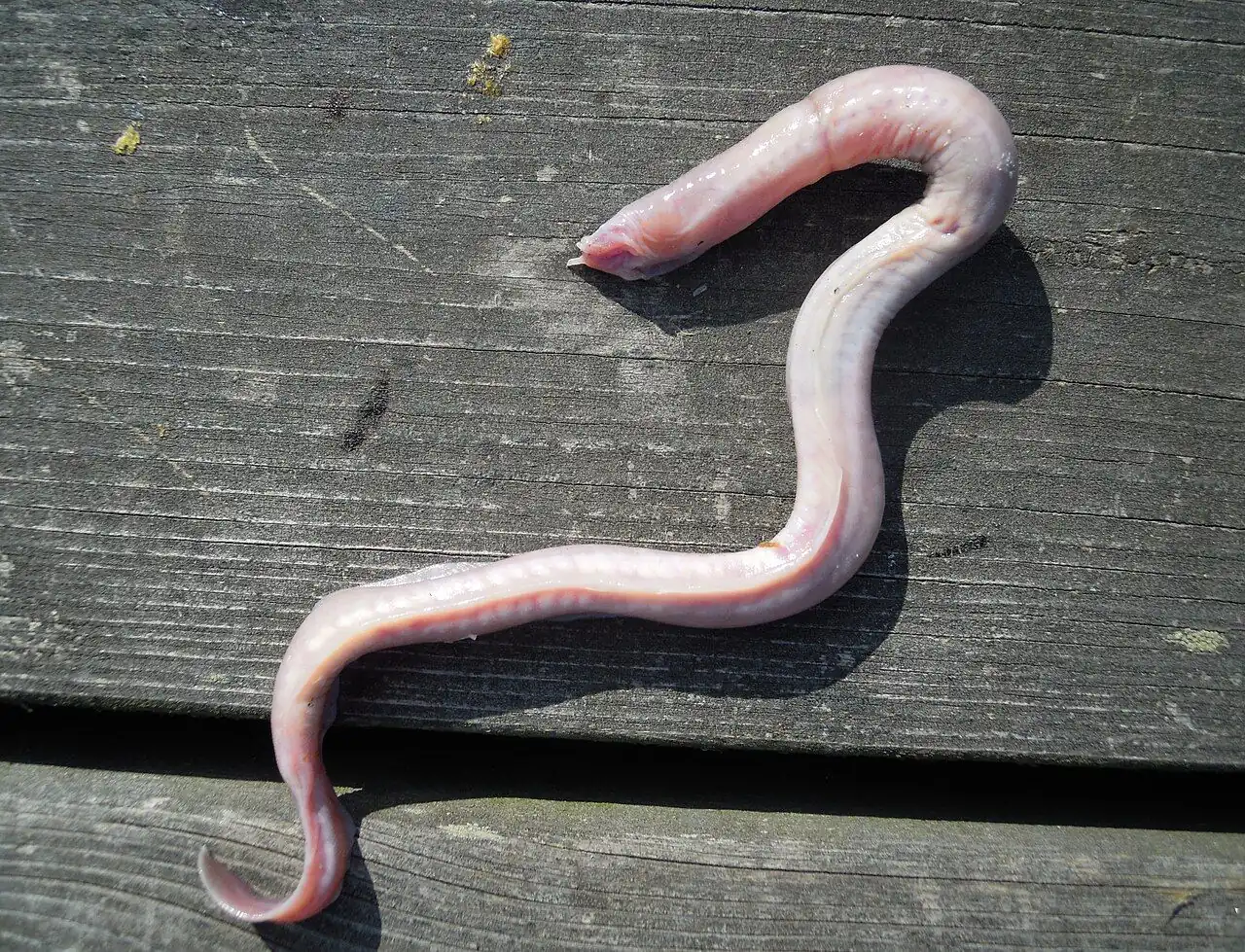
Atlantic Hagfish
Myxine glutinosa
A jawless, eel-shaped scavenger of North Atlantic mud that defends itself with slime and was once caught by the ton for eelskin leather.
Photo: Arnstein Rønning / CC BY-SA 3.0
3 things to know
- In one Gulf of Maine study, females outnumbered males almost 10 to 1.
- A female produces fewer than 30 eggs, each 20 to 25 mm (about 1 in) long.
- By 1997, fewer than 200 of its eggs had been found in 150 years, and only 4 were fertilized.
- Scientific name
- Myxine glutinosa
- Depth
- 27 m – 460 m
89 – 1,509 ft - Size
- Commonly 30 to 40 cm (12 to 16 in); FishBase lists up to 95 cm (3.1 ft), but the largest of 202 in a Gulf of Maine study was 72 cm (28 in)
- Weight
- Not well known
- Lifespan
- Unknown
- Diet
- Mainly dead and dying fish; also northern shrimp
- Where
- North Atlantic, from Greenland and Canada to the US East Coast, and from Russia's Murmansk coast to the Mediterranean
- IUCN status
- Least Concern
- Depth zones
- Sunlight · Twilight
Grayish or reddish brown above, often matching the seafloor where it lives, the Atlantic hagfish is a jawless, eel-shaped fish with a single nostril and one pair of gill openings. FishBase gives common lengths of 30 to 40 centimeters (12 to 16 inches), with females the larger, and a maximum of 95 centimeters (3.1 feet); in a Gulf of Maine sample of 202, the longest was 72 centimeters (28 inches). When something attacks it, it defends itself with slime.
It lives across the North Atlantic, from Greenland to the United States in the west and from Russia's Murmansk coast to the Mediterranean in the east, and FishBase calls it the only hagfish in the northeast Atlantic. It hides in soft mud on the continental shelf and slope, usually 27 to 460 meters (90 to 1,510 feet) down; for the western Atlantic the IUCN gives 75 to 742 meters. Mostly active at night, it feeds chiefly on dead and dying fish, boring into the body to eat the organs and muscle, and it has long been known to feed on fish trapped in fishing gear. Some biologists treat the western Atlantic hagfish as a separate species, Myxine limosa, but the IUCN's assessors found the differences too slight to split them without more study.
Frederic Martini and colleagues from Cornell University's Shoals Marine Laboratory sampled hagfish about 50 kilometers (30 miles) offshore in the Gulf of Maine and, in a 1997 NOAA Fishery Bulletin paper, reported that females outnumbered males 9.8 to 1, a skew seen on both sides of the Atlantic that remains unexplained. Each female produces fewer than 30 large, yolky eggs, and there seems to be no set breeding season. Where the eggs are laid is unknown. In 150 years, fewer than 200 had been recovered, and only four of those were fertilized.
That slow rate of breeding worried the team because of a new fishery. American and Canadian fishermen had begun fishing for Gulf of Maine hagfish for South Korea's "eelskin" leather trade, in which leather goods made from hagfish skin brought in about $100 million in 1990. In 1993 and 1994, Gulf of Maine boats landed roughly 1,600 metric tons (3.6 million pounds). The IUCN lists the species as Least Concern, in a 2009 assessment marked as needing an update.



