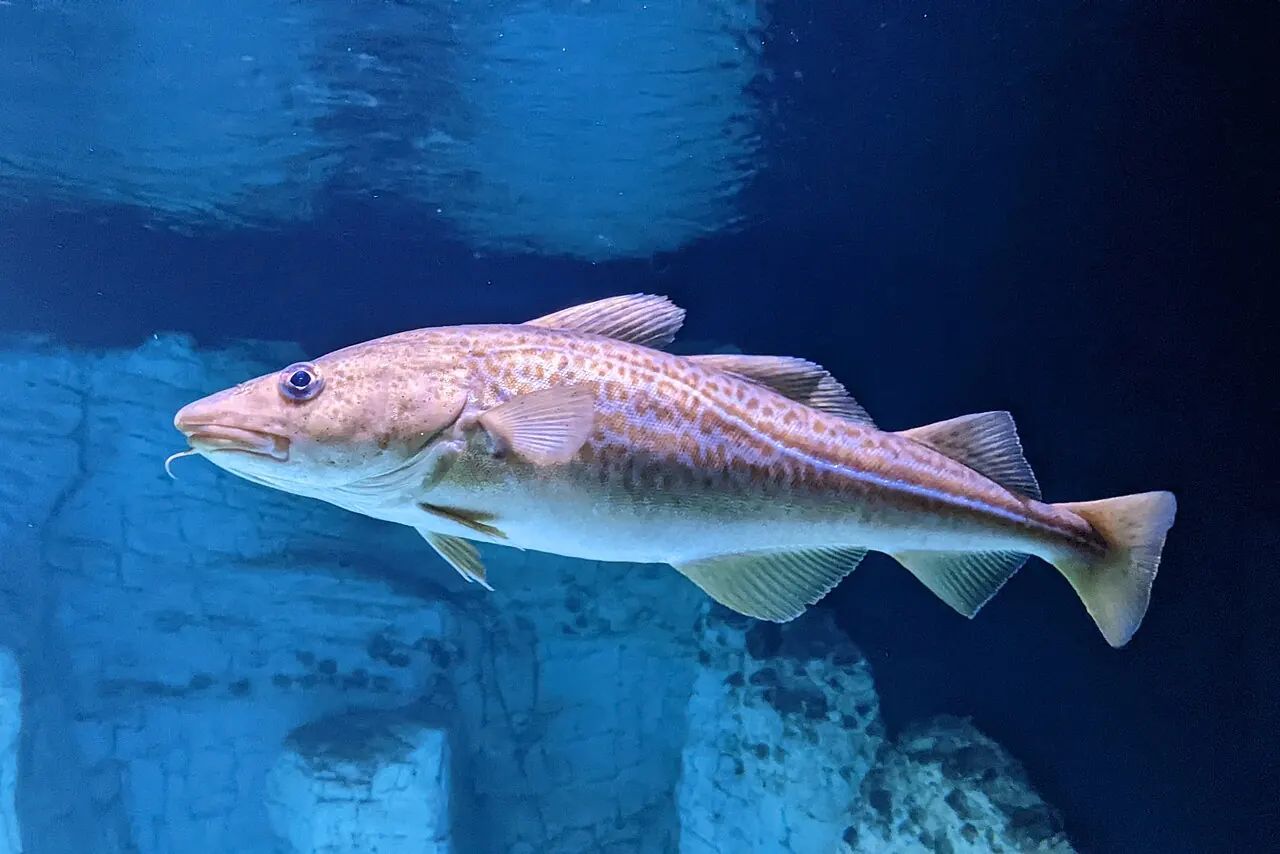
Atlantic Cod
Gadus morhua
The fish Cape Cod is named for, whose collapsed northern stock off Newfoundland was closed to fishing in 1992 and judged healthy again in 2026.
Photo: Wilhelm Thomas Fiege / CC BY-SA 4.0
3 things to know
- Atlantic cod have a whisker-like barbel under the lower jaw.
- The record egg count for a cod is 9 million, from a 34-kilogram (75-pound) female.
- Before Canada closed the northern cod fishery in 1992, the fish had been maturing younger and smaller.
- Scientific name
- Gadus morhua
- Depth
- 9 m – 200 m
30 – 656 ft - Size
- Up to about 130 cm (51 in) in US waters; FishBase lists a maximum of 2 m (6.6 ft)
- Weight
- Up to about 35 kg (77 lb) in US waters; the heaviest published is 96 kg (212 lb)
- Lifespan
- More than 20 years; FishBase gives a maximum reported age of 25 years
- Diet
- Bottom invertebrates and fish, including young cod
- Where
- North Atlantic and Arctic; in the west from Greenland and northern Canada to Cape Hatteras, North Carolina; in the east from the Barents Sea to the Bay of Biscay
- IUCN status
- Vulnerable
- Depth zones
- Sunlight
Cape Cod got its name from this fish. NOAA Fisheries says early explorers found cod so abundant off New England that they named the cape for it, and a carved pine "sacred cod" has hung in the Massachusetts State House since 1784. An Atlantic cod is heavy-bodied, with a large head, a blunt snout and a whisker-like barbel under the lower jaw. Its color runs from yellowish-green to red or olive, usually speckled darker, with a pale belly and an obvious pale lateral line along each side. A cod can change color readily.
Cod live near the bottom over rocky slopes and ledges, in cold water across the North Atlantic, from Cape Hatteras, North Carolina, north to Greenland and east to the Barents Sea. In US waters they are most common on Georges Bank and in the western Gulf of Maine, usually at about 9 to 150 meters (30 to 500 feet). By day they often school 30 to 80 meters above the bottom, then spread out at night to feed. They eat invertebrates and fish, including young cod. Spawning happens near the bottom in winter and early spring. A large female can release 3 to 9 million eggs, and FishBase records 9 million from a 34-kilogram (75-pound) female.
Off southern Labrador and eastern Newfoundland, the stock called northern cod went through what Esben Olsen and colleagues called one of the worst collapses in the history of fisheries. Canada closed directed fishing for it in July 1992. In a 2004 Nature paper, the same team showed that, right up to the moratorium, northern cod had been maturing at younger ages and smaller sizes, a shift they linked to evolution driven by fishing.
Canada ended the moratorium on June 26, 2024, with a quota of 18,000 metric tons, and on June 12, 2026, its fisheries department said that for the first time since 1992 the science showed northern cod in the healthy zone, raising the catch limit from 38,000 to 59,000 metric tons.
Farther south, NOAA says US waters hold fewer cod than their average over the past four decades. Its 2024 assessments rated all four US stocks overfished, and two were also subject to overfishing. The IUCN lists Atlantic cod as Vulnerable, but that assessment dates from 1996.
Sources
- fisheries.noaa.gov/species/atlantic-cod
- fishbase.se/summary/Gadus-morhua.html
- Study: doi:10.1038/nature02430
- canada.ca/en/fisheries-oceans/news/2024/06/the-government-of-canada-announces-the-histo…
- canada.ca/en/fisheries-oceans/news/2026/06/northern-cod-quota-to-increase-55-per-cent-m…
- Study: doi:10.2305/IUCN.UK.1996.RLTS.T8784A12931575.en
- api.gbif.org/v1/species/8084280/iucnRedListCategory
- iucnredlist.org/species/8784/12931575



