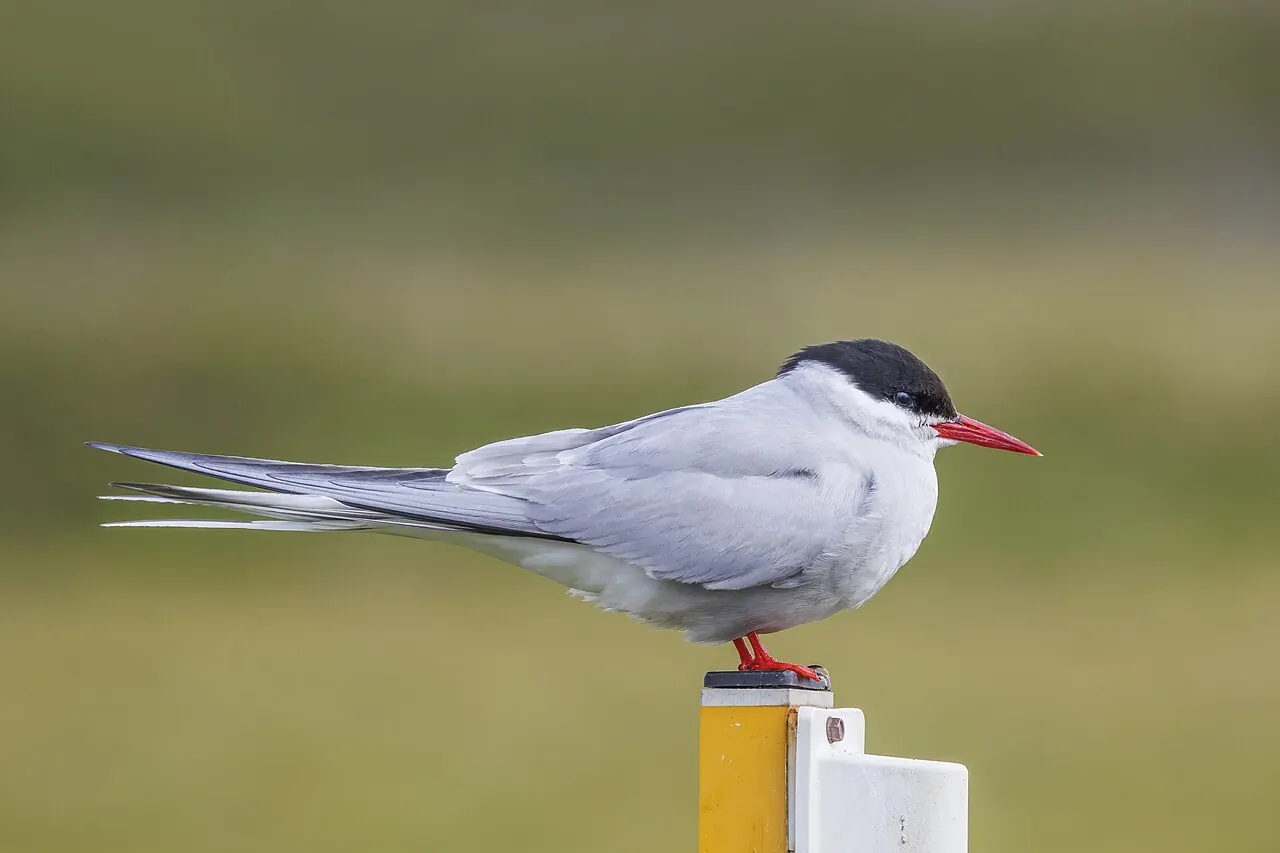
Arctic Tern
Sterna paradisaea
A small tern that follows the summer from pole to pole, flying farther each year than almost any other animal tracked.
Photo: Charles J. Sharp / CC BY-SA 4.0
3 things to know
- Tagged Arctic terns from Greenland and Iceland flew an average of 70,900 km (44,000 mi) in a year.
- It hovers, then plunges no deeper than about half a meter (20 in) for its prey.
- Parents dive at and strike intruders near the nest.
- Scientific name
- Sterna paradisaea
- Depth
- 0 m – 1 m
0 – 3 ft - Size
- 35–42 cm (14–16.5 in) long, with a wingspan of 76–85 cm (30–33 in)
- Weight
- 85–125 g (3–4.4 oz)
- Lifespan
- Typically about 13 years once breeding; the British ringing record is 31 years
- Diet
- Small fish and crustaceans; also insects on the breeding grounds
- Where
- Breeds around the Arctic and subarctic, south to New England and Britain; spends the northern winter in the Southern Ocean near Antarctica
- IUCN status
- Least Concern
- Depth zones
- Sunlight
Gray and white with a black cap, a solid red bill in summer and a forked tail that ends in long streamers, the Arctic tern is a slim, short-legged bird. It is 35 to 42 centimeters (14 to 16.5 inches) long and weighs only 85 to 125 grams (3 to 4.4 ounces).
It breeds all around the top of the world, in North America as far south as New England, and travels south in time for a second summer in the Antarctic, where it patrols the edge of the pack ice. In 2007 Carsten Egevang and colleagues fitted 1.4-gram geolocators to terns nesting on Sand Island in northeast Greenland and on Flatey Island in Iceland. The 11 birds whose tags were recovered had traveled an average of 70,900 kilometers (44,000 miles) between leaving the colony in August and returning in late May or early June, some more than 80,000 kilometers (50,000 miles). They stopped over in the North Atlantic, flew south along either the African or the South American coast, and came back on an S-shaped route across the Atlantic. Because Arctic terns can live more than 30 years, the authors estimated that a lifetime's travel could pass 2.4 million kilometers (1.5 million miles), about three round trips to the Moon.
Terns hunt by flying slowly into the wind, hovering, and plunging. The plunges are shallow: Joanne Morten and colleagues, citing earlier work, note that the birds are restricted to about the top half meter (20 inches) of the water, so they depend on prey near the surface. They take small fish and crustaceans, and on the breeding grounds they also catch insects.
Pairs usually lay one to three eggs, which both parents incubate for 20 to 24 days. Chicks first fly at three to four weeks old and stay with their parents for another month or two. Adults defend the nest hard, diving at intruders and striking them. The British Trust for Ornithology gives a typical lifespan of 13 years for a bird that reaches breeding age, and its ringing record is a tern of 31 years.
The IUCN lists the Arctic tern as Least Concern, in a 2018 assessment. Audubon's guide reports a steady decline at the southern end of its Atlantic Coast breeding range.
Sources
- Study: doi:10.1073/pnas.0909493107
- pmc.ncbi.nlm.nih.gov/articles/PMC2836663
- Study: doi:10.3389/fmars.2021.760670
- audubon.org/field-guide/bird/arctic-tern
- bto.org/understanding-birds/birdfacts/arctic-tern
- rspb.org.uk/birds-and-wildlife/arctic-tern
- Study: doi:10.2305/IUCN.UK.2018-2.RLTS.T22694629A132065195.en



