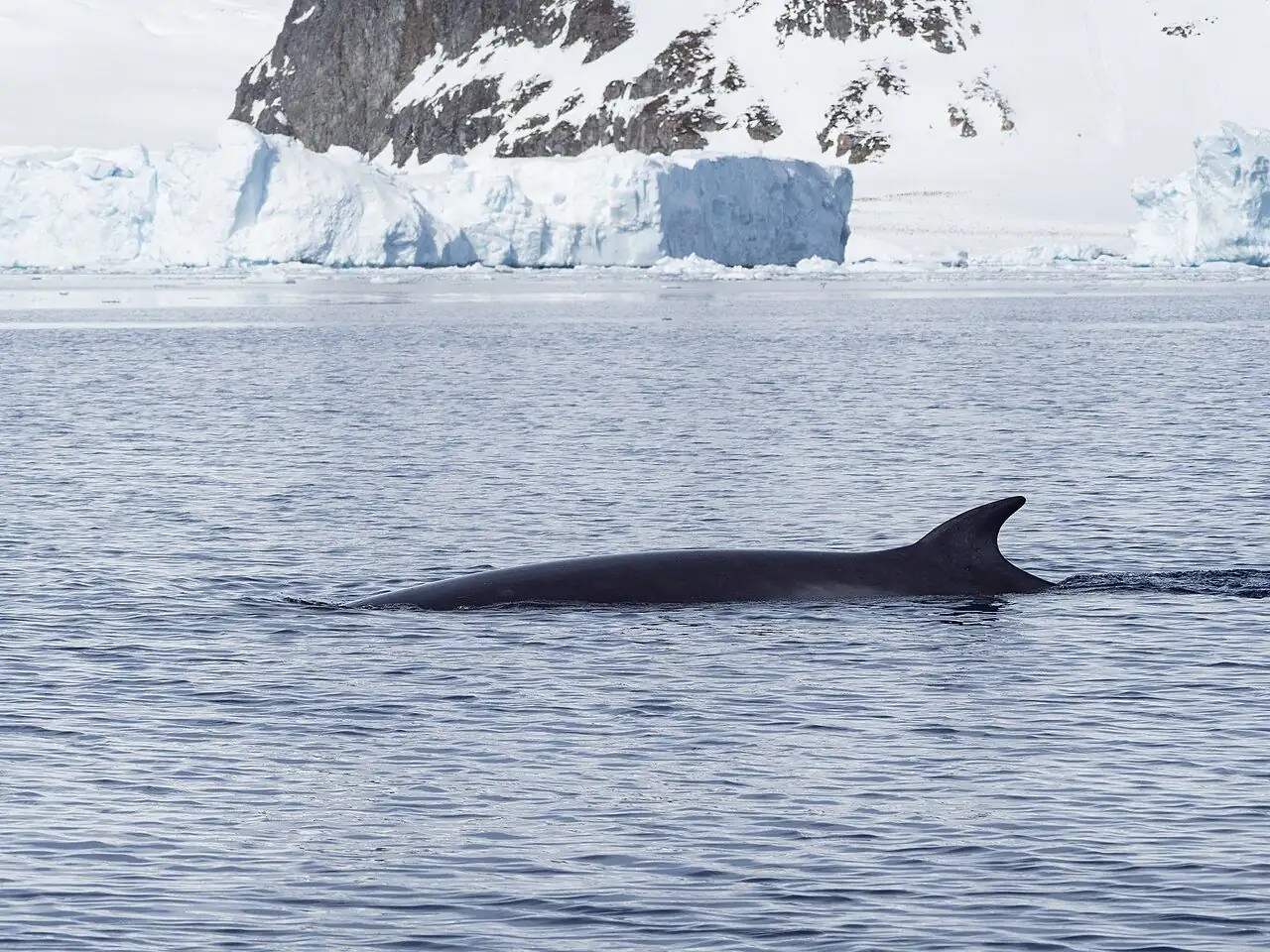
Antarctic Minke Whale
Balaenoptera bonaerensis
A small, ice-loving baleen whale that lunges for krill under Antarctic sea ice and turned out to be the source of the bio-duck sound.
Photo: Carina Gsottbauer / CC BY-SA 4.0
3 things to know
- Tagged Antarctic minke whales packed up to 24 lunges into a single foraging dive around and beneath sea ice.
- It is the source of the bio-duck, a Southern Ocean sound named by submarine crews in the 1960s.
- The IWC accepted an estimate of about 500,000 from surveys between 1993 and 2004.
- Scientific name
- Balaenoptera bonaerensis
- Depth
- 0 m – 100 m
0 – 328 ft - Size
- Up to about 8.9 m (29 ft) for females and 8.4 m (28 ft) for males
- Weight
- Up to about 6.8 metric tons (15,000 lb)
- Lifespan
- Not well known
- Diet
- Almost entirely krill while in the Antarctic
- Where
- Southern Hemisphere; summers in the Antarctic south of 60° S, near and inside the pack ice
- IUCN status
- Near Threatened
- Depth zones
- Sunlight
Dark gray above and clean white below, the Antarctic minke whale has a narrow, pointed snout and a tall, curved dorsal fin set about two-thirds of the way back. It lacks the bright white flipper band that common minke whales carry in the Northern Hemisphere. Records in SeaLifeBase give lengths of up to 8.9 meters (29 feet) for females and 8.4 meters (28 feet) for males, and a top weight of about 6.8 metric tons (15,000 pounds).
In summer these whales are abundant throughout the Antarctic south of 60° south, densest near the edge of the pack ice but also inside it and in open pools within the ice. The IUCN calls them ice-loving, better able than larger baleen whales to use heavy pack ice. There they feed almost entirely on krill; whether they feed much on their wintering grounds is not known. They may also be important prey for one type of Antarctic killer whale.
In February 2013, Ari Friedlaender and colleagues tagged two minke whales feeding among the ice floes of Wilhelmina Bay on the Antarctic Peninsula. Over 18 and 8 hours, the tags logged 2,831 lunges in 649 dives, some reaching about 100 meters (330 feet). Foraging dives around and beneath the sea ice contained up to 24 lunges per dive, which the authors called the highest feeding rates for any lunge-feeding whale, and some of those lunges skimmed the underside of the ice. One tag also settled an old puzzle. The bio-duck, a repetitive quacking sound named by submarine crews in the 1960s and heard around the Southern Ocean ever since, showed up on its recording just before a feeding dive. Denise Risch and colleagues reported in 2014 that Antarctic minke whales make it.
Whalers took nearly 100,000 in the Antarctic between 1972 and 1987, and Japan took nearly 11,000 more under scientific permits from 1987 to 2014. In March 2014 the International Court of Justice ruled that the permits for Japan's JARPA II program were not for scientific research, and in 2019 Japan withdrew from the convention behind the International Whaling Commission and stopped taking whales in the Antarctic. The IUCN's 2018 assessment lists the species as Near Threatened: the 1993 to 2004 surveys came out 31 percent below those of 1986 to 1991, a drop that is not statistically significant, and the IUCN notes concern that shrinking sea ice could harm it.
Sources
- iucnredlist.org/species/2480/50350661
- sealifebase.se/summary/Balaenoptera-bonaerensis.html
- Study: doi:10.1242/jeb.106682
- Study: doi:10.1098/rsbl.2014.0175
- en.wikipedia.org/wiki/Antarctic_minke_whale
- icj-cij.org/case/148
- mofa.go.jp/ecm/fsh/page4e_000969.html
- phys.org/news/2014-08-minke-whales-lunge-hour-sea.html
- nationalgeographic.com/science/article/little-giant-whales-take-100-gulps-an-hour



