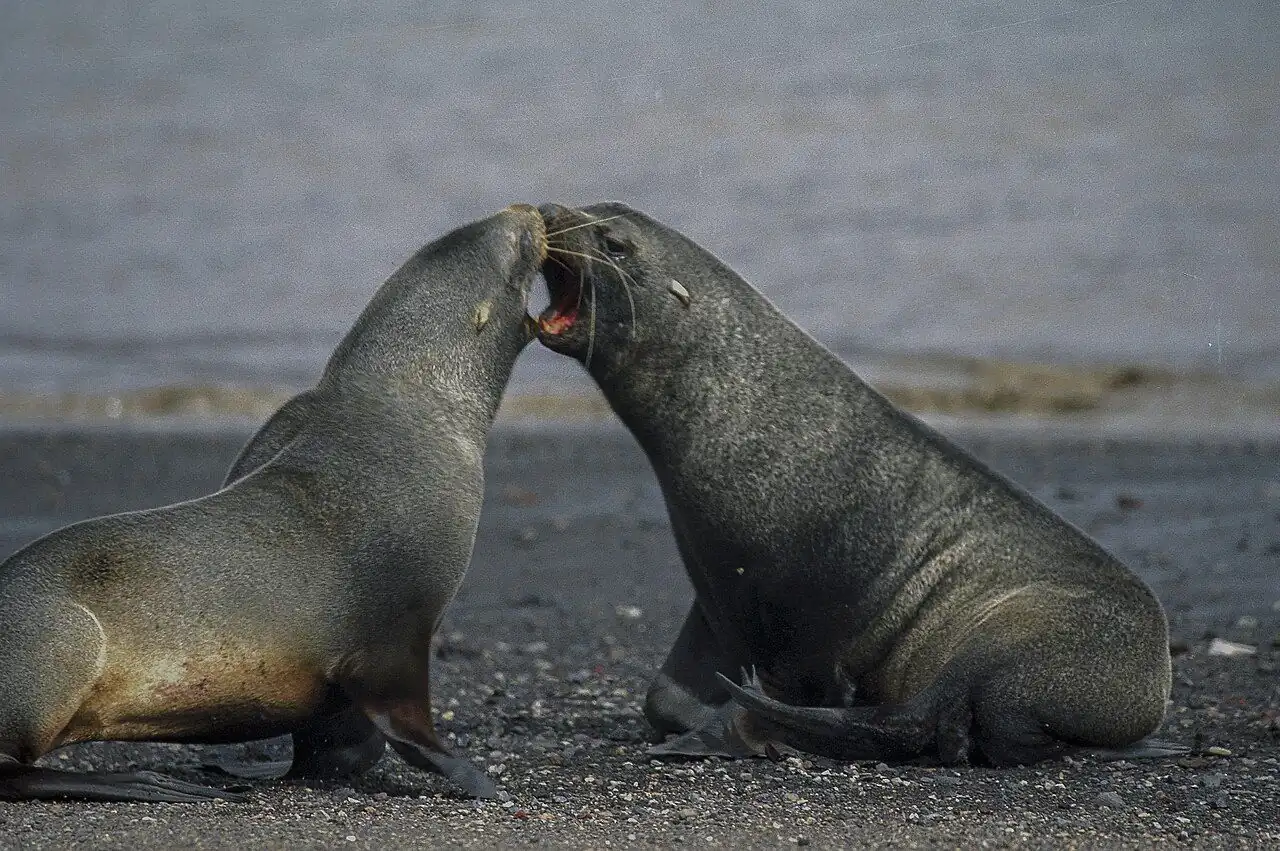
Antarctic Fur Seal
Arctocephalus gazella
A Southern Ocean fur seal that came back from near-extinction to millions, then lost more than half its adults; the IUCN listed it Endangered in 2026.
Photo: Jerzy Strzelecki / CC BY-SA 3.0
3 things to know
- More than 90 percent of the world's Antarctic fur seals live at South Georgia.
- The mature population fell from about 2.2 million in 1999 to about 944,000 in 2025.
- At Cape Shirreff, leopard seals have eaten almost 70 percent of the pups born each year since 2010.
- Scientific name
- Arctocephalus gazella
- Depth
- 0 m – 181 m
0 – 594 ft - Size
- Males average about 1.8 m (5.9 ft); females about 1.3 m (4.2 ft)
- Weight
- Males average about 133 kg (293 lb); females about 34 kg (75 lb)
- Lifespan
- Females up to about 25 years; males up to about 15
- Diet
- Antarctic krill and fish such as mackerel icefish, plus squid; males sometimes take penguins
- Where
- Southern Ocean islands, from South Georgia and the South Shetlands to Bouvetøya, Kerguelen, Heard and Macquarie; more than 90 percent at South Georgia
- IUCN status
- Endangered
- Depth zones
- Sunlight
In 2026 the IUCN Red List moved the Antarctic fur seal from Least Concern straight to Endangered. The new assessment estimates that the world's mature population fell from about 2,187,000 in 1999 to about 944,000 in 2025, a drop of roughly 57 percent. It says the change of category reflects newly available data rather than a change since the previous assessment, in 2016.
The fall follows a famous comeback. Sealers nearly wiped the species out for its fur in the 1800s, but small groups survived on remote islands. Once hunting stopped they multiplied quickly, above all at South Georgia, which holds more than 90 percent of the population; a survey there in 2007–2009 suggested about 3.5 million fur seals. Since then numbers have fallen at South Georgia, Bouvetøya and, most steeply, the South Shetland Islands. The assessment links the decline mainly to warming that is thought to be limiting the supply of Antarctic krill, with recovering whales, krill fishing, pollution including plastics, and H5N1 bird flu as possible added pressures.
In the South Shetlands, NOAA Fisheries biologist Douglas Krause, who has studied Antarctic fur seals for more than 20 years, estimates that the colony at Cape Shirreff on Livingston Island has shrunk by 86 percent since 2007, and that leopard seals have eaten almost 70 percent of the pups born there each year since 2010. Genetic studies show this small southern population carries a share of the species' genetic diversity out of proportion to its size.
Males are four to five times heavier than females, averaging about 1.8 meters (5.9 feet) and 133 kilograms (293 pounds) against the females' 1.3 meters (4.2 feet) and 34 kilograms (75 pounds), and wear a grizzled mane. Their whiskers, up to 45 centimeters (18 inches) in bulls, are the longest of any seal or sea lion. Mothers alternate feeding trips of about five days with nursing until weaning at about four months. Krill and fish such as mackerel icefish make up most of the diet. The IUCN gives the species' depth range as the surface to 181 meters (594 feet). Females live up to about 25 years, males about 15.



