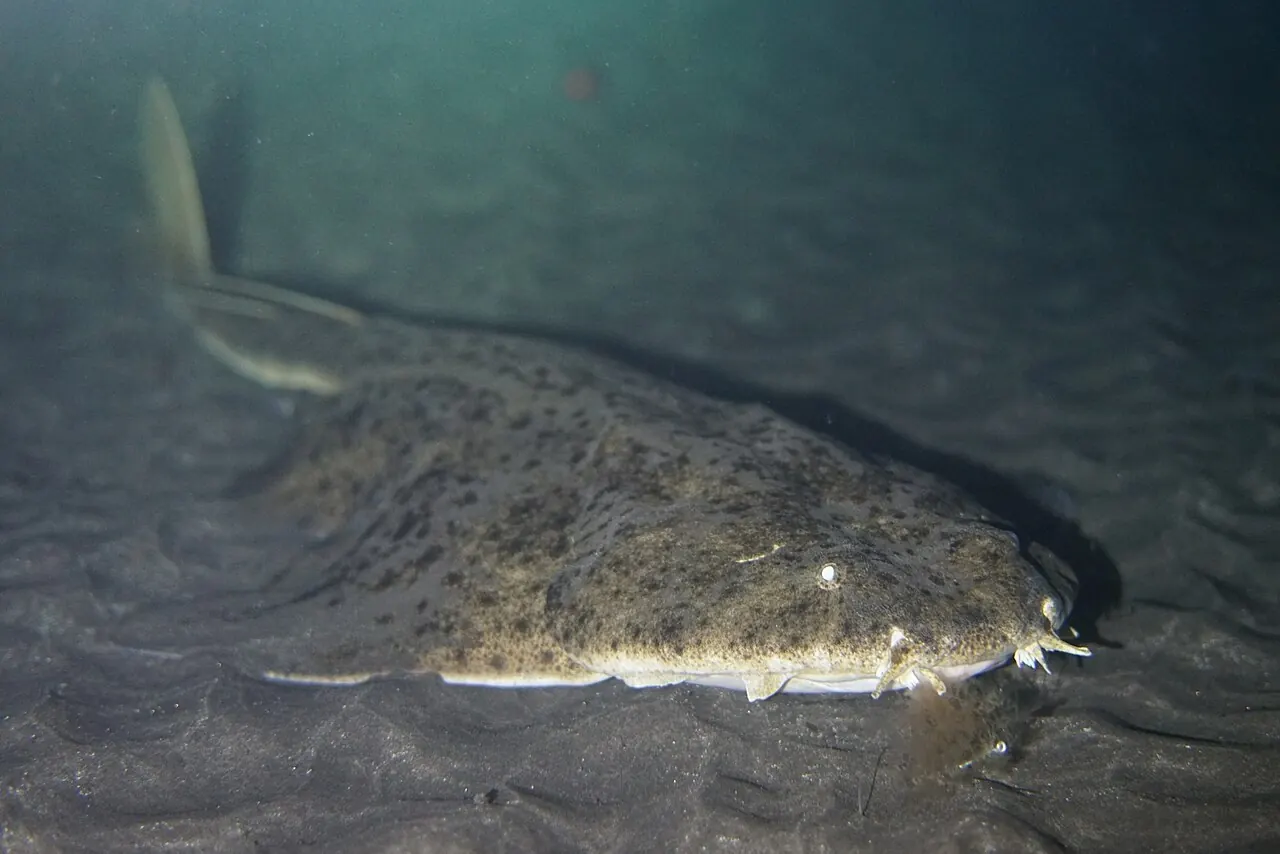
Angelshark
Squatina squatina
A flat, sand-colored shark that lies buried on the seabed to ambush fish, now Critically Endangered across most of its old European range.
Photo: Michael Bommerer / CC BY 4.0
3 things to know
- Its eyes and large spiracles, the openings it breathes through, sit on top of its flattened head.
- Citizen scientists in the Canary Islands reported 678 angelshark sightings in a single year.
- Since 2019 it has been illegal to kill, capture or disturb an angelshark in Canary Island waters.
- Scientific name
- Squatina squatina
- Depth
- 0 m – 150 m
0 – 492 ft - Size
- Up to about 2.4 m (8 ft); females grow larger than males
- Weight
- Up to about 80 kg (176 lb)
- Lifespan
- Not well known
- Diet
- Mainly flatfishes and other bottom fishes; also skates, crustaceans and molluscs
- Where
- Northeastern Atlantic and the Mediterranean Sea; now found only in scattered populations, with its stronghold in the Canary Islands
- IUCN status
- Critically Endangered
- Depth zones
- Sunlight
Flattened like a ray but built like a shark, the angelshark spends its days buried in sand or mud with little more than its eyes showing. Its pectoral and pelvic fins spread wide to the sides and its eyes and large spiracles sit on top of its head. Its coloring varies from gray to reddish or greenish brown, with small white spots and dark dots that match the seabed. Females grow larger than males, to about 2.4 meters (8 feet).
It lives on sandy and muddy bottoms in the northeastern Atlantic and the Mediterranean, from the shallows to about 150 meters (490 feet), and moves into deeper water in winter. By day it lies still; at night it is more active and swims off the bottom. It ambushes flatfishes and other bottom fishes, along with skates, crustaceans and molluscs, and it can sense the weak electric fields given off by prey. Females give birth to 7 to 25 live pups, which feed only on yolk before birth.
Three angel shark species once lived throughout the eastern Atlantic and Mediterranean. All three are now listed as Critically Endangered, and the Zoological Society of London says they have disappeared from much of their historic range. European Union rules have banned fishing for, keeping or landing the angelshark in EU waters since 2009.
The Canary Islands are the exception. The angelshark is found there in much greater numbers, and divers and fishers still see it regularly. Through a citizen-science program, Eva Meyers and colleagues collected 678 sightings around the islands between April 2014 and March 2015, and published them in 2017. Angelsharks turned up at all seven islands, from less than 1 meter to 45 meters (148 feet) deep, mostly on sand next to reefs. Newborn pups appeared only in water shallower than 25 meters, and sightings of both females and newborns peaked from April to July, the pupping season. Males were most common from November to January, the mating season.
The Angel Shark Project, run since 2013 by the University of Las Palmas de Gran Canaria, Germany's Leibniz Institute for the Analysis of Biodiversity Change and the Zoological Society of London, works in the Canaries with divers and sport fishers. In 2019 Spain added the angelshark to its endangered species list for Canary Island waters, making it illegal to kill, capture or disturb one or damage its habitat.
Sources
- fishbase.se/summary/Squatina-squatina.html
- zsl.org/what-we-do/projects/angel-shark-conservation
- zsl.org/news-and-events/feature/saving-critically-endangered-angel-shark
- angelsharknetwork.com/canaryislands
- Study: doi:10.1002/aqc.2769
- api.gbif.org/v1/species/2417781/iucnRedListCategory
- iucnredlist.org/species/39332/117498371



