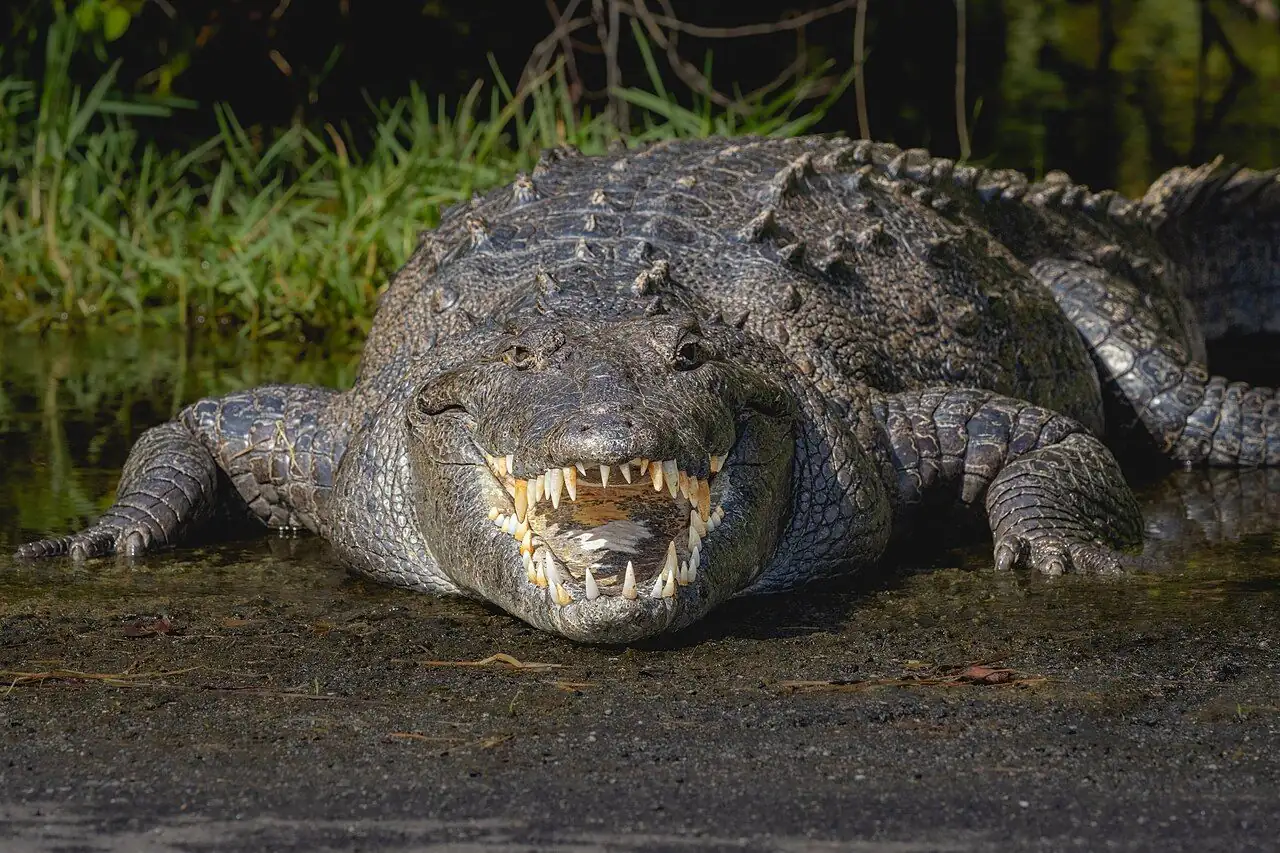
American Crocodile
Crocodylus acutus
A narrow-snouted crocodile of mangrove coasts and salty bays that has made a comeback in south Florida, helped by a power plant's cooling canals.
Photo: Everglades National Park (NPS) / Public domain
3 things to know
- South Florida is the only place where American crocodiles and American alligators live side by side.
- Florida went from an estimated 10 to 20 breeding females in 1975 to 1,400 to 2,000 crocodiles in 2005.
- The cooling canals at the Turkey Point power plant held 25 crocodile nests in 2005.
- Scientific name
- Crocodylus acutus
- Depth
- 0 m – 40 m
0 – 131 ft - Size
- Males can reach about 6 m (20 ft) but rarely exceed 4.3 m (14 ft) in the wild; breeding females are about 2.4–3.7 m (8–12 ft)
- Weight
- Not well known
- Lifespan
- Typically 50–70 years in the wild, according to the National Park Service
- Diet
- Adults eat fish, crabs, turtles, birds, snakes and small mammals; young eat small fish, snails, crustaceans and insects
- Where
- Coasts of south Florida and the Keys, Cuba, Jamaica and Hispaniola, both coasts of Mexico and Central America, south to Peru and Venezuela
- IUCN status
- Vulnerable
- Depth zones
- Sunlight
South Florida is the only place where American crocodiles and American alligators live side by side, the National Park Service notes, and the crocodile is easy to tell apart. It is paler, grayish green above, with a narrow, tapering snout, and the fourth tooth on each side of the lower jaw shows when its mouth is shut. Males can reach about 6 meters (20 feet) but rarely exceed 4.3 meters (14 feet) in the wild.
This is a coastal animal. It lives in brackish and salt water, in mangrove ponds, creeks and coves, from south Florida and the Keys through Cuba, Jamaica and Hispaniola, along both coasts of Mexico and Central America, and south to Peru and Venezuela. Like the saltwater crocodile it has salt glands in its tongue, described by Taplin and colleagues in 1982. Hatchlings move to sheltered nurseries with lower salinity, and how fast they grow depends on access to fresh water. Measured dive depths for this species are scarce; its IUCN assessment sets a depth limit of 40 meters (130 feet). Adults feed mostly at night on fish, crabs, turtles, snakes and small mammals.
Females lay 20 to 60 eggs in nests of sand or soil built above the high-water mark, and the incubation temperature decides whether the young will be male or female. The park service gives a typical wild lifespan of 50 to 70 years.
Florida's crocodiles were listed as endangered in 1975, when an estimated 10 to 20 breeding females remained. By 2005 the state had an estimated 1,400 to 2,000 crocodiles, not counting hatchlings, and 91 to 94 nests, and in 2007 the US Fish and Wildlife Service reclassified the Florida population as threatened. One unlikely refuge helped: the cooling canals of the Turkey Point power plant on Biscayne Bay, built in 1974, went from 1 or 2 nests a year between 1978 and 1981 to 25 nests in 2005, the second largest breeding group in the state.
Across its whole range the IUCN lists the species as Vulnerable, and it may be more than one species. In 2025 José Avila-Cervantes, Hans Larsson of McGill University and colleagues reported that crocodiles on Cozumel and on the Banco Chinchorro atoll, both off Mexico's Yucatán Peninsula, are distinct enough to be two new, still unnamed species, each with fewer than 1,000 breeding animals.
Sources
- home.nps.gov/ever/learn/nature/crocodile.htm
- myfwc.com/wildlifehabitats/wildlife/american-crocodile
- federalregister.gov/documents/2007/03/20/E7-5037/endangered-and-threatened-wildlife-and…
- fws.gov/species/american-crocodile-crocodylus-acutus
- Study: doi:10.1007/BF00735713
- Study: doi:10.1016/j.ympev.2025.108341
- sciencedaily.com/releases/2025/05/250506170923.htm
- iucnredlist.org/species/5659/212805700



